Push Pull Legs on GLP-1: Why PPL Is the Right Structure for a Caloric Deficit
TL;DR
- Push pull legs works well on semaglutide because it fits the constraints the drug creates: lower energy, weekly nausea windows, and limited recovery.
- Volume is what drives muscle preservation, not how many sessions you split it across. When weekly sets are equated, three sessions and six sessions produce the same results.
- Three days puts total weekly gym time at roughly four hours including commute. Six days doubles that. For most people with jobs and families, that difference is the line between a program that fits and one that doesn’t.
- The six-day version makes sense if you have a home gym or don’t mind a daily commute and want sessions short enough to fit a 45-minute window.
- GLP-1 makes sustainability the binding constraint. The program you actually run for ten months beats the theoretically optimal program you abandon at month two.
Push pull legs on semaglutide at three days a week isn’t a compromise, it’s the right dose of structure for most people on GLP-1 who aren’t training at an advanced level. The evidence points the same direction the time math does, and both point at three days.
Why Push Pull Legs on Semaglutide Works at Three Days a Week
The case for PPL on GLP-1 isn’t about frequency. It’s about what frequency actually does and what it doesn’t.
Volume is the driver; frequency is just distribution
The research has been consistent on this: when total weekly sets are equated, spreading them across three sessions or six sessions produces equivalent strength and hypertrophy gains (Colquhoun et al., J Strength Cond Res, 2018;32(5):1207-1213). Frequency is a tool for distributing your volume into manageable chunks, not a variable that adds a bonus on top of the volume you’re already doing. If you can complete 6–8 hard sets for a given muscle group in one session (which at minimum effective dose you can) the argument for splitting that across two sessions collapses.
Where the 80–90% figure comes from
The small gap between one session per muscle per week and two is most meaningful for advanced lifters who need high enough weekly volume that fitting it into a single session becomes impractical. At the 4–8 set preservation target that governs GLP-1 training, that ceiling doesn’t apply. A push day with 8 hard sets for chest, shoulders, and triceps fits cleanly in 35–40 minutes. There’s no overflow to distribute. Running a second push session to split those sets would add commute time and recovery cost without adding stimulus.
Download the free GLP-1 Starter Framework, the three-lever system for losing fat without losing muscle.
The Time Math Behind Choosing Three Days
I ran PPL from day one. Part of that decision was mechanical; PPL is one of the most efficient ways to hit minimum effective volume for every primary muscle group while keeping sessions short enough to be sustainable. But the time math was also a real consideration.
Push, pull, and legs gave each session one clear job. It also kept the workouts short enough that I could keep training during a deficit without turning every session into a 90-minute negotiation with low energy.
A typical session runs about 80 minutes door to door: 15 minutes of commute each way, 5 minutes of warm-up and activation work, 35–40 minutes of lifting, 10 minutes to shower and change. Three sessions a week puts total gym time at roughly four hours. A six-day rotation doubles that.
For someone with a job, a big family, and a life, doubling the weekly time investment is not a minor tradeoff, it’s the difference between a program that fits and one that doesn’t.
The compound lift structure reinforces this. Each session in a PPL split stacks movements by pattern: push sessions hit chest, shoulders, and triceps through pressing; pull sessions hit back and biceps through rowing and pulling; leg sessions cover the lower body through squats and hinges. No redundancy, no filler, and because the movements are compound, you’re recruiting the most muscle per set that you can. The result is a program that achieves its muscle preservation objective in roughly the time it takes to watch a film.
What a 3-Day PPL Session Looks Like
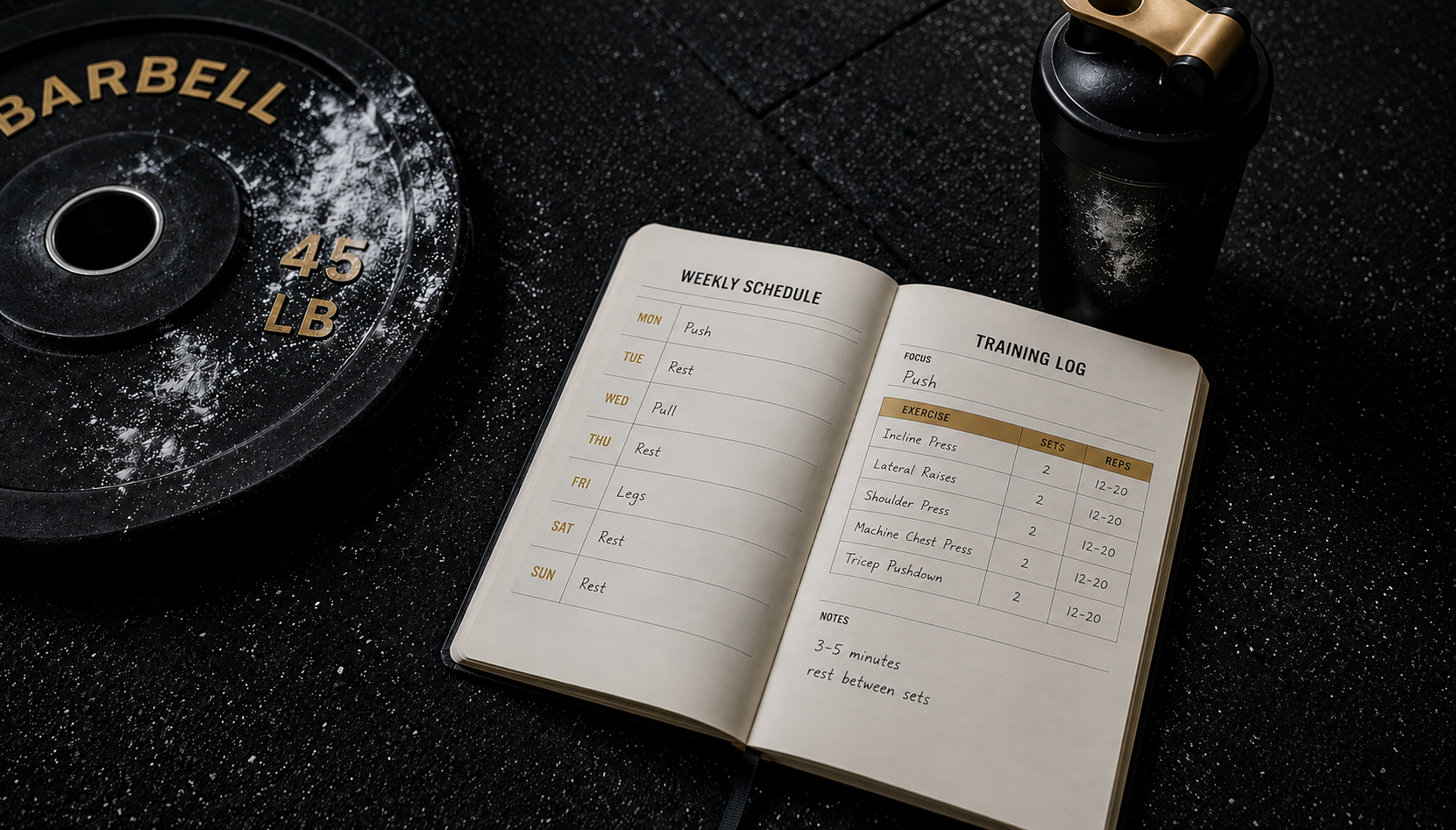
Three sessions a week means one push, one pull, one leg day. Each muscle group trained once, with enough volume in that session to satisfy the preservation signal. Here’s what that looks like in practice.
The push session
One primary horizontal press, one vertical press, one incline press, 1 delt-isolation and 1 tricep isolation movement. Two hard sets each, one to two reps from failure.
Total working sets for the session: 10. Time in the gym: 35–40 minutes.
The pull session
One horizontal row targeting the lats, one vertical pull (lat pulldown or pull-up), one horizontal row targeting upper back, one bicep movement, 1 rear delt isolation exercise. Same rep protocol.
Total: 10 working sets.
The leg session
One squat pattern (hack squat or leg press), one hinge (Romanian deadlift or hamstring curl), one quad isolation movement (leg extensions), one hamstring isolation movement (leg curls or nordic curls), and a calf movement. The hip hinge is where most of the posterior chain work lives.
Total: 10 working sets.
Each session is intentionally flat — no supersets required, no elaborate sequencing, no accessories beyond what moves the compound needle. The movements are compound by design, so you’re getting broad muscle recruitment without needing to pad sessions with isolation work.
For how hard each of those sets needs to be, see why training near failure matters more than set count — proximity to failure is what makes a low-volume session do real work.
When the 6-Day Version Makes More Sense
The six-day rotation isn’t better or worse than three days, it’s better for a specific user in a specific situation.
Who it suits
If you have a home gym, or you train somewhere you can reach without adding 30 minutes of travel, the commute math changes completely. A home gym session with a 5-minute warm-up and 30 minutes of lifting lands at 35–40 minutes total. Six of those in a week is under four hours — comparable to three commuted sessions. If the commute is zero or close to it, doubling the frequency costs you almost nothing in time.
The same applies if you genuinely prefer shorter, more focused sessions. The six-day version splits the same weekly volume into smaller pieces, so each individual session is lighter. Some people train better when each session has a narrower scope. If that’s you, and the logistics allow it, six days works.
What changes
The split structure is identical — push, pull, legs, but repeated twice. Session length drops because each muscle group’s weekly sets are split across two exposures instead of one, which means fewer sets per session. Everything else; the compound-first movement selection, the proximity-to-failure standard, the minimum effective volume target stays the same.
Fitting the Floor Into This Structure
When a dose escalation hits or a bad week arrives, the three-day structure has a built-in floor: drop to two full-body sessions that week, cover the primary patterns, and step back up to the PPL rotation when you feel human again. That fallback is covered in full in the GLP-1 training floor protocol, and scheduling around the injection-day nausea window is in how to time training around your injection day.
Transitioning From Your Current Program
From full-body 3x/week
You’re already on the right frequency. Convert by redistributing the movements you’re already doing into push, pull, and leg sessions. Monday’s bench press stays on push day; Monday’s rows move to pull day; Monday’s squats stay on leg day. Same three days, same total volume, better movement-pattern organization.
From a bro split
A classic bro split trains each muscle once a week and often runs five or six days. Consolidate it: fold chest, shoulders, and triceps into one push day; back and biceps into one pull day; everything lower into legs. You drop from five or six days to three, cut commute time nearly in half, maintain the same weekly volume for each muscle group, and gain two days of recovery.
The Bottom Line
Push pull legs at three days a week isn’t the advanced version of PPL — it’s the right version for most people on semaglutide. Volume drives the result; frequency is just how you chop it up; and three hard, compound-focused sessions in roughly four hours a week preserves lean mass as effectively as a schedule that asks twice as much of your time. The six-day version is a real option if your logistics allow it and shorter sessions suit you better. But if you’re working around a commute, a job, and a family, three days is the number that keeps the program in your life long enough to matter.
For the volume targets that determine how many sets each of those sessions needs, see the minimum effective training dose on GLP-1. The full strength training guide for GLP-1 users puts the structure, effort, and scheduling together in one place.
Download the free GLP-1 Starter Framework — the three-lever system for losing fat without losing muscle. ryanmercer.gumroad.com/l/txhvrr
The GLP-1 Training Protocol ($27) has the full PPL program with both schedule variants, progression rules, GLP-1-specific modifications, and a pre-built Training Tracker spreadsheet. ryanmercer.gumroad.com/l/pxnnup
FAQ
Is push pull legs on semaglutide the best split for GLP-1 muscle preservation?
For most people on GLP-1 who aren’t at an advanced training level, yes. PPL organizes compound movements by pattern, hits each muscle group with enough volume to drive preservation, and keeps sessions short enough to sustain through low energy and weekly nausea windows. Three days a week captures 80–90% of what a higher-frequency program produces and for a preservation goal in an active deficit, that gap is irrelevant.
How many days a week should I do PPL on GLP-1?
Three is the baseline, and for most people it’s the right call. It puts total weekly gym time at roughly four hours including commute, and when volume is equated, three sessions produce the same results as six. If you have a home gym or can train without a meaningful commute and prefer shorter focused sessions, six days is worth considering, the total time investment becomes comparable. Match the frequency to your actual logistics, not to what sounds optimal.
Does training each muscle once a week build less muscle than twice a week?
The research shows the frequency advantage collapses when total weekly volume is held equal, three and six sessions per week produced equivalent gains when sets were matched (Colquhoun et al., 2018). The twice-per-week advantage is most meaningful for advanced lifters who need more total volume than fits in one session per muscle. At the 4–8 set preservation range that applies on GLP-1, there’s no overflow to distribute.
Is full-body or PPL better on a GLP-1?
Both can preserve muscle, but they suit different situations. Full-body runs longer sessions and trains every pattern each day, fine if your energy is stable and you prefer the format. PPL sessions are shorter because each day has a narrower scope, and the structure is more modular: a missed pull day costs back and biceps for that week, not a third of every muscle group. If your schedule and energy are consistent, either works. If they aren’t, PPL absorbs a missed session better.
Can I keep my old program and just adjust it for GLP-1?
Usually yes. A full-body 3x program converts directly to a three-day PPL by redistributing the movements you already do into push, pull, and leg days. A bro split consolidates from five or six days to three, raising each muscle from one hard session to one hard session with better compound movement selection. The adjustment is mostly organizational, you’re matching volume to the right pattern structure, not rebuilding from scratch.
Nothing on this site constitutes medical advice. I’m not a physician, and this blog documents my own research and experience. Consult a qualified healthcare provider for decisions about medication, dosing, or treatment.
— Ryan Mercer | MetabolicMale.com | ryanmercer@metabolicmale.com
References
- Schoenfeld BJ, Ogborn D, Krieger JW. Effects of resistance training frequency on measures of muscle hypertrophy: a systematic review and meta-analysis. Sports Med. 2016;46(11):1689-1697. https://doi.org/10.1007/s40279-016-0543-8
- Colquhoun RJ, et al. Training volume, not frequency, indicative of maximal strength adaptations to resistance training. J Strength Cond Res. 2018;32(5):1207-1213. https://doi.org/10.1519/JSC.0000000000002414