What ‘Body Recomposition’ Actually Means — And Why Scale Weight Is the Wrong Metric
TL;DR
- Body recomposition meaning, in one line: changing the ratio of fat to lean mass, dropping fat while holding or gaining muscle, over the same period. It’s not a bulk-then-cut.
- Scale weight is a uniquely bad metric on GLP-1: early water and glycogen loss inflates the number, and lean mass loss is completely invisible on it.
- The default outcome on GLP-1 is real lean loss, about 25% of weight lost across the pooled trials, in people with no preservation strategy.
- Track DEXA every 12 weeks, circumferences monthly, and strength on your main lifts. Scale weight is a weekly trend line, not the headline.
- Most GLP-1 users have the beginner advantage, untrained and carrying excess fat, which makes recomposition genuinely achievable right now.
Picture this: a man loses 20 pounds on semaglutide over five months. Gets a DEXA scan. The results show that five of those pounds were lean mass: muscle, bone, water, connective tissue. The scale said he won. The DEXA told him he gave back something he can’t easily get back.
That gap, between what the scale shows and what’s actually happening inside your body, is why body recomposition matters, and why most GLP-1 users are measuring the wrong thing.
This article explains the meaning of body recomposition for GLP-1 users, why scale weight is a bad primary metric in this context, and what to track instead if you want to know whether you are actually preserving muscle.
The three-lever framework this whole site is built around comes at the end, because it only makes sense once you understand what you’re trying to track. If you want that framework now rather than later, the free GLP-1 Starter Framework is where it lives.
What Body Recomposition Actually Means
Body recomposition means changing the ratio of fat mass to lean mass, reducing fat while maintaining or gaining fat-free mass, over the same period. It’s not a bulk-cut cycle. It’s not lose weight now, rebuild later. It’s a concurrent process.
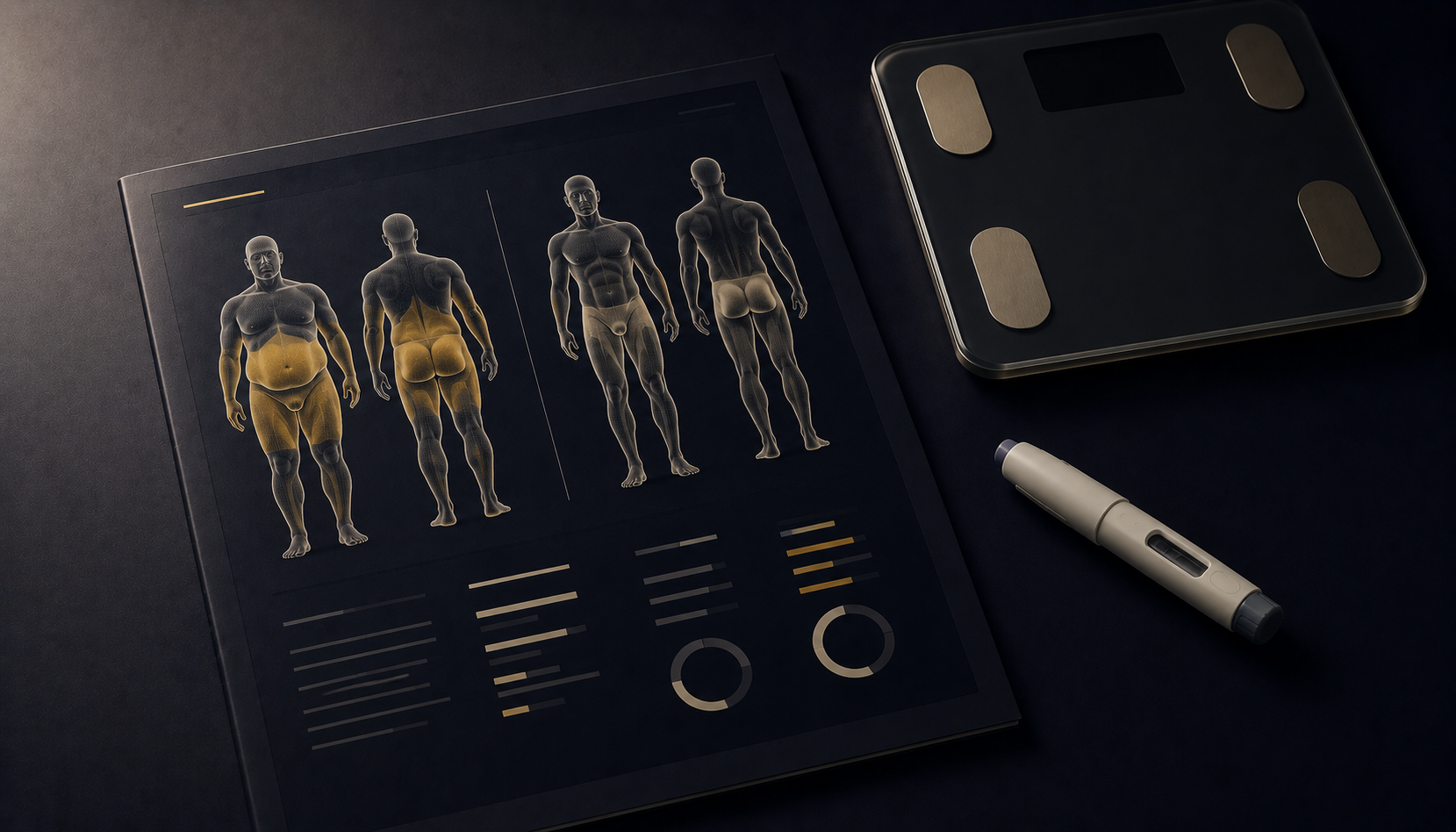
That distinction matters more than it sounds. Two people can lose the same number on the scale and end up with completely different bodies. One loses mostly fat and keeps his muscle. The other loses a meaningful chunk of lean tissue alongside the fat. They weigh the same at the end. They don’t look the same, don’t perform the same, and six months later the one who lost lean mass finds it harder to hold the loss, because muscle is metabolically active tissue, and less of it means a lower baseline caloric burn.
The precise definition: a reduction in absolute fat mass and/or fat mass percentage, occurring alongside preservation or gain in fat-free mass (FFM), over the same time period. FFM includes skeletal muscle but also water, bone mineral content, and connective tissue, so “lean mass” and “muscle mass” aren’t interchangeable. That nuance matters when reading trial data, because a several-kilogram lean mass reduction in a clinical trial is worse than it sounds and not quite as bad as it looks, depending on what drove it.
For GLP-1 users, the realistic primary target is lean mass preservation: holding FFM constant while fat drops. True recomposition (net muscle gain concurrent with fat loss) is possible but harder, particularly at meaningful caloric deficits. Preservation is the non-negotiable floor. Building is the upside. Protecting lean mass first is the right frame.
Why Scale Weight Is a Particularly Bad Metric on GLP-1
Scale weight is a useful trend variable over weeks. It’s a poor signal on any given day, and it’s particularly distorted in the first months of GLP-1 therapy. Three reasons specific to this context.
Early water and glycogen loss inflates initial results. When you significantly reduce food intake, which GLP-1 does by suppressing appetite, your body rapidly depletes muscle glycogen. Each gram of glycogen is stored with roughly 3 grams of water. A meaningful reduction in intake over the first two to three weeks produces several pounds of scale loss that has nothing to do with fat.
Early in my own protocol, the scale was dropping faster than my tracked deficit said it should. I’d been logging the deficit closely, and the math said actual fat loss was running well behind the scale. The gap was water and glycogen. The scale was telling me I was ahead of schedule. The math was telling me I was roughly on it. Trusting the math over the scale that early is what kept the later normalization from feeling like failure. Your mileage may vary on the tooling, but the principle holds.
That early acceleration is real on the scale. It’s not real in the mirror, and it won’t persist. Users who treat week-three scale results as exceptional fat loss are reading a signal that will normalize, and will feel like a plateau when it does.
Lean mass loss is invisible on the scale. This is the core measurement failure mode for GLP-1 users, and the one with real consequences. Lose three pounds of fat and one pound of lean mass in a month and the scale shows four pounds down. That reads as progress. The lean mass loss doesn’t register until your strength declines or a DEXA scan catches it, and by then, several weeks of silent lean tissue loss are behind you.
The trial data is worth sitting with: across the pooled analysis of 22 randomized trials, lean mass accounted for about 25% of total weight lost in populations with no specific preservation strategy (Karakasis P, Patoulias D, Fragakis N, Mantzoros CS. Metabolism. 2025;164:156113). In the STEP 1 DXA substudy, absolute lean mass fell 9.7% even as lean proportion rose about 3 points, because fat dropped faster (Wilding JPH et al. Journal of the Endocrine Society. 2021). That’s the default on GLP-1, and the scale reported all of it as progress.
Fluid shifts from reduced carbohydrate intake further distort the signal. Beyond the initial glycogen flush, ongoing reduced carbohydrate intake keeps a lower glycogen reservoir throughout active therapy. Body weight runs a few pounds below what fat mass change alone would predict. Reintroduce carbohydrates at any point, a higher-carb day, a vacation, a break, and the scale jumps. That isn’t fat gain. It’s glycogen and the water that comes with it. Without understanding this, the rebound reads as a setback.
What to Track Instead
Scale weight still belongs in the tracking stack, as a weekly trend variable, not a daily signal. Use a seven-day rolling average to smooth out noise. But it can’t be the primary metric.
DEXA scan: the reference standard for body composition. Fat mass, lean mass, and bone mineral density with meaningful accuracy. Commercial DEXA access varies by location, so check local pricing and availability. The trend across scans matters more than the exact price or the exact number from any one scan.
The protocol: baseline before or early in therapy, then retest twelve to sixteen weeks into the program and when you hit your goal weight.
Circumference measurements: waist, mid-thigh, and mid-arm, every four weeks. Waist dropping while thigh and arm hold is a good sign fat is leaving and lean mass isn’t. Free, simple, directionally reliable, as long as you measure the same location and tape tension each time.
Strength performance as a proxy: if your squat, bench press, and cable row hold within 5% of where they were at the start, lean mass is almost certainly preserved. Strength tracks lean mass closely enough that performance maintenance during weight loss is a reliable practical heuristic. Caveat: it’s a proxy, not a clinical threshold. A 3–5% temporary dip from the deficit that stabilizes isn’t an alarm. A 10%+ progressive decline across multiple sessions is.
Scale weight: still useful. Track daily, read weekly as a trend. It tells you total mass is changing. It tells you nothing about what’s changing. The deeper STEP 1 body composition data shows exactly why the composition, not the total, is the report card.
The Beginner Advantage (And Why Most GLP-1 Users Have It)
Recomposition is most achievable in two specific populations: untrained individuals new to resistance training, and those with significant excess adiposity. Barakat C et al. (Strength Cond J. 2020;42:7-21) reviewed the recomposition evidence systematically and found the strongest data in exactly these groups.
Most GLP-1 users have both characteristics. That’s not consolation framing. It’s a physiological advantage.
The untrained adaptation: someone new to resistance training produces substantial muscle protein synthesis even on a modest mechanical stimulus. The training-naive state means a lower threshold for triggering adaptation. A minimum-effective-dose protocol produces results a trained lifter would need far more volume to match.
The adiposity advantage: more body fat means a larger reservoir of stored energy to mobilize against the deficit. When fat stores are abundant, the body preferentially draws from them rather than lean tissue. This partitioning advantage diminishes as body fat drops, but for the typical GLP-1 user starting with meaningful excess adiposity, it’s a real protective factor.
Both advantages are time-limited. The untrained window closes as the body adapts. The adiposity advantage shrinks as fat drops. That’s why the right protocol from the start matters. The window is open now.
Tracking the right metrics only matters if you’re pulling the right levers. On GLP-1, those levers are protein intake, resistance training, and rate of weight loss, none of which the standard prescribing protocol addresses. The three variables that determine whether you lose fat or muscle lays them out in full, and the complete framework is where they become a protocol.
Get the Framework
Download the free GLP-1 Starter Framework, the three-lever system for losing fat without losing muscle.
If you want the data behind the scans and trial findings in one place, GLP-1 & Body Composition explains the lean mass evidence, body composition caveats, and what the numbers actually mean.
FAQ
What does body recomposition mean?
Body recomposition means changing the ratio of fat to lean mass, losing fat while maintaining or gaining muscle, over the same period, rather than in separate “bulk” and “cut” phases. The scale can stay flat or barely move while your body changes substantially, because fat and muscle are being swapped, not just subtracted. For GLP-1 users, the realistic version is preservation: holding lean mass steady while fat drops, with net muscle gain as the achievable upside.
Why is the scale a bad metric on GLP-1?
Because it measures total mass, not composition, and GLP-1 distorts it in three ways. Early appetite suppression flushes glycogen and the water bound to it, inflating week-one results. Lean mass loss is invisible, since losing fat and muscle together still reads as “progress.” And ongoing low-carb intake keeps body weight running below what fat change predicts, so any carb reintroduction looks like fat gain. The scale belongs in the stack as a weekly trend, not the headline number.
What should a GLP-1 user track instead of scale weight?
A stack: a DEXA scan at baseline and every 12 weeks for objective fat and lean mass; circumference measurements at waist, mid-thigh, and mid-arm every four weeks as a free proxy; and strength on your main compound lifts as the most accessible lean mass indicator. Keep tracking scale weight too, but read it as a seven-day rolling average and a trend line, not as evidence of what the weight loss is actually made of.
How often should a GLP-1 user get a DEXA scan?
Get a baseline scan before or early in therapy, then another about twelve to sixteen weeks into the program, and when you hit your goal weight. That cadence is frequent enough to catch lean mass slipping while there’s still time to adjust protein, training, or rate of loss, but not so frequent that normal measurement variation drowns out the signal. Treat each result as hovering within a small range; the trend across scans matters more than any single number.
Can beginners build muscle and lose fat at the same time?
Yes, and beginners are the group most able to. The recomposition evidence is strongest in people new to resistance training and those carrying significant excess body fat (Barakat et al., 2020), which describes most GLP-1 users. Untrained muscle responds strongly to even modest training, and abundant fat stores let the body draw the deficit from fat rather than muscle. Both advantages fade with training experience and fat loss, so the early window is the time to act.
Nothing on this site constitutes medical advice. I’m not a physician, and this blog documents my own research and experience. Consult a qualified healthcare provider for decisions about medication, dosing, or treatment.
— Ryan Mercer | MetabolicMale.com | ryanmercer@metabolicmale.com
Citations:
Karakasis P, Patoulias D, Fragakis N, Mantzoros CS. Effect of glucagon-like peptide-1 receptor agonists and co-agonists on body composition: Systematic review and network meta-analysis. Metabolism. 2025;164:156113.
Wilding JPH et al. STEP 1 body composition substudy. Journal of the Endocrine Society. 2021.
Barakat C et al. Body Recomposition: Can Trained Individuals Build Muscle and Lose Fat at the Same Time? Strength Cond J. 2020;42:7-21.