
When to Reduce Training Volume on GLP-1 (And When You’re Just Making Excuses)
TL;DR
- Training volume in a GLP-1 deficit should be managed by benchmarks, not by how tired you feel. Fatigue is the background state of a deficit, not an automatic reason to reduce sets.
- A 2–3 week stall on your key lifts is not a volume problem. It’s the first indicator for a deload: one week of reduced intensity, kept session structure, let the system recover.
- A 5% or more decline on your benchmarks is a signal to audit your inputs — sleep, nutrition, stress, rate of loss before touching the program.
- A sustained 10%+ decline means something systemic is broken. Find it before reducing anything.
- Volume reduction is the last tool in the sequence, not the first response to a bad stretch.
Training volume in a GLP-1 deficit is a benchmark decision, not a mood decision. Most people feel tired, have a few flat sessions, and immediately assume the program needs to change. But hard weeks are part of training in a caloric deficit. The number on the bar is the better instrument. The question is what that instrument is telling you and what response comes next.
The First Response to a Stall: Take a Deload
A stall is two to three weeks where your key lifts aren’t moving but are not declining, not advancing, just parked. Most people read a stall as a programming problem and start adjusting sets, exercises, or frequency. Usually it’s none of those things. Usually it’s accumulated fatigue suppressing expression of a fitness level that has actually continued to develop underneath it.
The right response to a stall is a deload: one week of reduced intensity, kept session structure. Same days, same movements, same sets but intensity pulled back to roughly 50–60% of normal working weight, with no effort to push close to failure. The objective is to let accumulated fatigue dissipate without losing the training habit or disrupting the weekly rhythm.
What a deload is and isn’t
A deload is not a rest week, and it’s not a reduction in volume. It’s a reduction in intensity while keeping everything else intact. You still go to the gym. You still run your session. You lift significantly lighter and stop well short of failure. The point is to allow the recovery system to catch up to the load you’ve been placing on it — something it couldn’t do while you were training at full intensity.
What to expect after
After a properly executed deload week, loads typically move again. The fitness adaptation that appeared stalled was accumulating; the fatigue masking it was not. When the fatigue clears, the adaptation becomes visible in the numbers. This is one of the more reliable patterns in resistance training and one of the most underused responses to a plateau.
There was one stretch in the protocol where an unscheduled deload was the right call. Fatigue had accumulated over several weeks, progress had stalled, and I could feel it in the joints, a kind of accumulated heaviness that’s distinct from having trained hard and is more accurately described as recovery running behind load. I reduced intensity for a week, kept the session structure, and let the system catch up.
The joints cleared. The weights moved better the following week. What I didn’t expect was the secondary effect: the lower-intensity week gave me a cleaner signal for what intense training actually feels like, without weeks of accumulated fatigue blunting the contrast. That’s a pattern I’ve watched undermine earlier training phases; the inability to modulate intensity meant that every stretch of high fatigue ended in stopping rather than pausing. Taking the deload when the data called for it, rather than pushing through on instinct, kept the protocol intact and produced a stronger return than forcing through would have.
Download the free GLP-1 Starter Framework — the three-lever system for losing fat without losing muscle. ryanmercer.gumroad.com/l/txhvrr
When Benchmarks Tell You to Audit Your Inputs
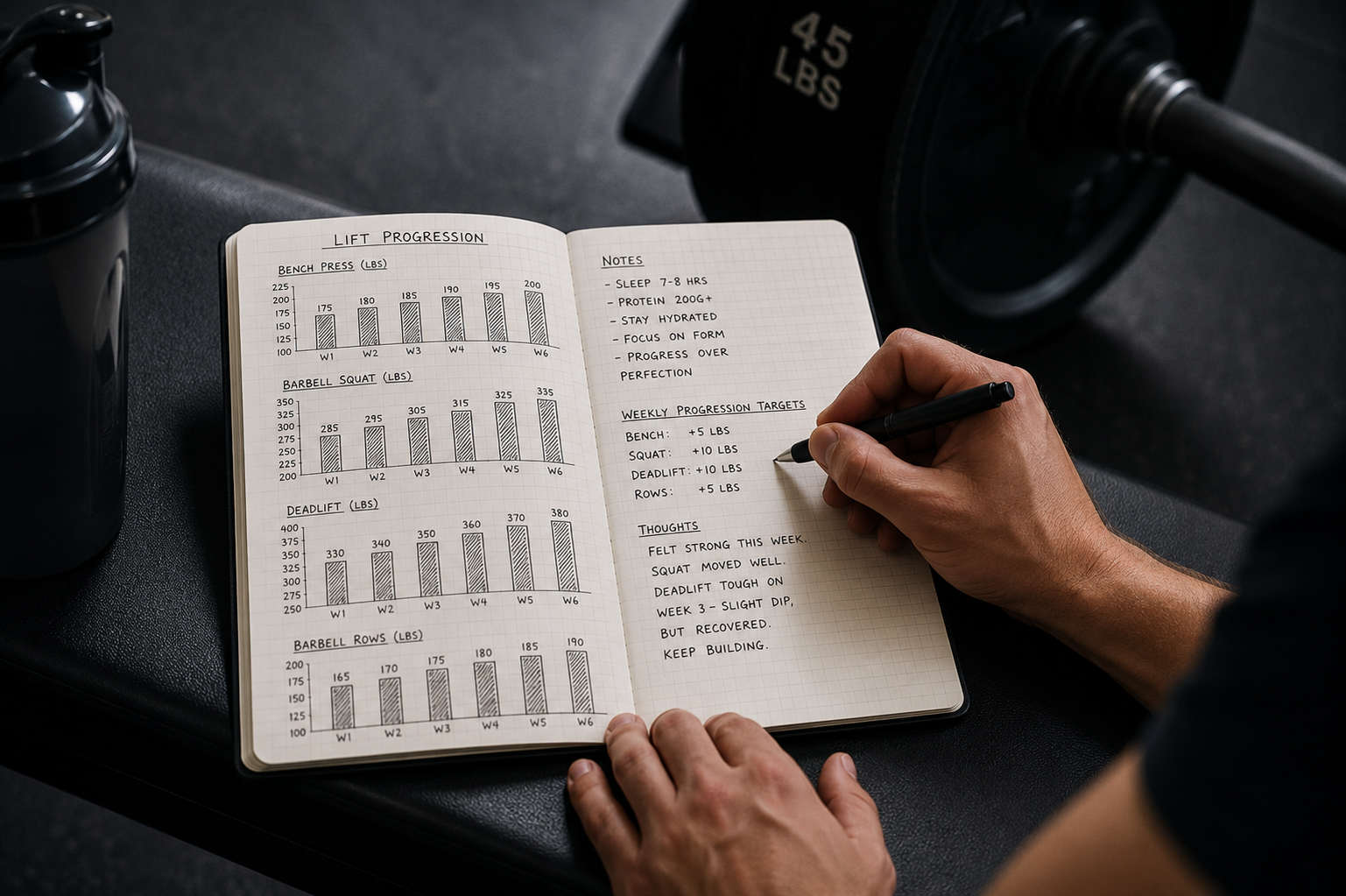
A stall that doesn’t resolve after a deload, or a decline in your benchmarks rather than a stall, points somewhere different. The tool for reading it is the same one you use for progressive overload decisions: track one key lift per movement pattern and watch the trend against where it sat at the start.
5% or more decline: audit first
A drop of 5% or more on your key lifts sustained across several sessions is a yellow-to-red signal. The response is an audit of your inputs before changing anything about the program. Four things to check in order:
Sleep. GLP-1 and a caloric deficit each degrade sleep quality independently. Sleep is when recovery happens. A stretch of poor sleep can produce a 5–10% performance decline with no other cause. Before assuming the problem is training-related, account honestly for whether your sleep has been adequate.
Protein. GLP-1 suppresses appetite, and suppressed appetite quietly drags protein intake down without you noticing. If protein has slipped under 1.6 g per kg of bodyweight, the anabolic signal that protects muscle in a deficit has weakened (Morton et al., Br J Sports Med, 2018;52:376-384). Strength decline from under-eating protein gets fixed at the plate, not in the program.
Rate of loss. Losing weight too fast is the most common hidden cause of strength decline on GLP-1. Losing at 1.4% of bodyweight per week cost athletes lean mass that 0.7% per week preserved (Garthe et al., Int J Sport Nutr Exerc Metab, 2011;21(2):97-104). If the scale is moving faster than roughly 1% of bodyweight per week and your lifts are sliding, the deficit is the problem. The full treatment is in how fast you should lose weight on GLP-1.
Stress load. Psychological stress and physical training stress draw on the same recovery resources. A high-stress period at work or at home can suppress performance meaningfully even when every training variable is unchanged. Account for it before attributing the decline to the program.
10%+ decline: systematic investigation before any change
A sustained decline beyond 10% across all key lifts is a red flag that something systemic is broken. Don’t reduce volume, restructure the program, or change frequency until you know what you’re fixing. The input audit above is where to start. A 10%-plus decline almost always has a recoverable upstream cause — and finding it before adjusting the program means the adjustment actually solves the problem rather than adding noise.
When Training Volume in a GLP-1 Deficit Actually Needs to Come Down
After a deload and a full input audit, if the decline persists, volume reduction may be the correct answer. When it is, do it precisely.
Drop sets, not exercises
Cut set count, not movements. Keep every compound lift in the program and reduce the sets on each by one. Drop accessories entirely before touching the compound main movements. The compound lifts carry the retention signal; the accessories are additive. Protect the signal.
Hold the reduction for as long as the cause lasts
A volume reduction is a response to a specific condition, not a permanent setting. Hold it until the upstream cause resolves, typically one to two weeks for a dose-escalation window, longer if you’re correcting rate of loss or protein. When the cause clears, add volume back one set at a time and watch the benchmarks as you climb. If they hold, keep adding.
The Bottom Line
Training volume in a GLP-1 deficit answers to one instrument: your key lift benchmarks. A stall means deload first. A 5%-plus decline means audit your inputs before touching the program. A 10%-plus decline means find the cause before changing anything. Volume reduction is the correct response to a narrower set of conditions than most people apply it to, and reaching for it first almost always addresses the wrong problem.
For the minimum volume that preserves lean mass, see the minimum effective training dose on GLP-1. The connection between rate of loss and benchmark decline is in how fast you should lose weight on GLP-1. The full strength training guide for GLP-1 users places volume decisions inside the complete protocol.
Download the free GLP-1 Starter Framework — the three-lever system for losing fat without losing muscle. ryanmercer.gumroad.com/l/txhvrr
The GLP-1 Training Protocol ($27) has the full PPL program with both schedule variants, progression rules, GLP-1-specific modifications, and a pre-built Training Tracker spreadsheet. ryanmercer.gumroad.com/l/pxnnup
FAQ
When should I reduce training volume in a GLP-1 deficit?
Volume reduction is the third tool in the sequence, not the first. A stall calls for a deload, one week of reduced intensity, same session structure, before anything changes. A 5%-plus decline on your key lifts calls for an input audit: sleep, protein, rate of loss, and stress load. Volume reduction comes after both of those have been tried and the decline persists. Most people reach for it first and solve the wrong problem.
What is a deload and when should I take one on GLP-1?
A deload is one week where you train at the same frequency and structure but cut intensity to roughly 50–60% of your normal working weight, stopping well short of failure. It’s the right response to a 2–3 week stall on your key lifts, to accumulated joint heaviness, or to persistent fatigue that isn’t resolving between sessions. It’s not a rest week because you still go and complete the session. After a proper deload, loads typically move again the following week as accumulated fatigue clears.
My lifts dropped 5% on GLP-1 — what do I do?
Deload + audit your inputs before touching the program. Check sleep quality first — GLP-1 plus a deficit both degrade sleep independently, and poor sleep can tank performance without any training cause. Then check protein because suppressed appetite quietly drops intake below the 1.6 g per kg floor without you noticing. Then check rate of loss, faster than 1% of bodyweight per week starts costing lean mass. Fix whichever of those is off and reassess after two weeks.
How do I know if a strength decline is serious on GLP-1?
A stall (no advance, no decline) is normal during dose escalation and resolves with a deload or when the escalation settles. A 5%-plus decline sustained across several sessions means an input is off; audit before adjusting anything. A 10%-plus decline across all key lifts is a systematic red flag: something is broken upstream, and reducing volume won’t fix it. Find the cause first.
Does losing weight too fast hurt my strength on GLP-1?
Yes, and it’s the most common upstream cause of benchmark declines people mistakenly attribute to training. Losing at 1.4% of bodyweight per week cost athletes lean mass that 0.7% per week preserved (Garthe et al., 2011). GLP-1 can push loss rates higher than intended because the appetite suppression is aggressive. If your rate of loss is running above roughly 1% per week and your lifts are sliding, slow the deficit before adjusting the program.
Nothing on this site constitutes medical advice. I’m not a physician, and this blog documents my own research and experience. Consult a qualified healthcare provider for decisions about medication, dosing, or treatment.
— Ryan Mercer | MetabolicMale.com | ryanmercer@metabolicmale.com
References
- Morton RW, et al. A systematic review, meta-analysis and meta-regression of the effect of protein supplementation on resistance training-induced gains in muscle mass and strength in healthy adults. Br J Sports Med. 2018;52(6):376-384. https://doi.org/10.1136/bjsports-2017-097608
- Garthe I, et al. Effect of two different weight-loss rates on body composition and strength and power-related performance in elite athletes. Int J Sport Nutr Exerc Metab. 2011;21(2):97-104. https://doi.org/10.1123/ijsnem.21.2.97