
Does Semaglutide Cause Muscle Loss? The Real Mechanism
TL;DR
- Does semaglutide cause muscle loss? Not pharmacologically. There’s no GLP-1 receptor pathway that breaks down muscle. The deficit it creates does the damage, not the drug.
- Skeletal muscle isn’t a meaningful GLP-1 target tissue. The drug suppresses appetite, slows gastric emptying, and dampens food reward, none of which signal muscle breakdown.
- Lean mass loss comes from a deficit run without enough protein and without a resistance training stimulus. Both are behavioral inputs you control.
- The hardest part on GLP-1 is protein, because the drug removes hunger as a feedback signal, so the shortfall happens silently unless you track.
- Fix the inputs and the lean mass loss in the trial data becomes the avoidable outcome, not the expected one.
Does semaglutide cause muscle loss? Not in any pharmacological sense, and that distinction matters more than most GLP-1 content acknowledges. GLP-1 receptor agonists have no direct catabolic effect on muscle tissue. There is no GLP-1 receptor-mediated pathway that signals muscle breakdown. Semaglutide, tirzepatide, and the rest of the class don’t degrade muscle directly.
What causes lean mass loss is a caloric deficit, specifically a deficit without adequate protein and without a resistance training stimulus telling the body to hold muscle. The drug creates the deficit. Three variables decide whether it comes from fat or muscle: protein intake, resistance training, and rate of loss. If you’d rather have those three as a ready-made protocol than read the mechanism, the free GLP-1 Starter Framework is built for exactly that.
The rest of this article explains the mechanism behind that reframe and why the constraint is behavioral, not pharmacological.
What GLP-1 Actually Does to Muscle (Nothing Direct)
The GLP-1 receptor (GLP-1R) is expressed across a surprisingly broad range of tissues: pancreatic beta and alpha cells, the hypothalamus, brainstem nuclei, vagal afferent neurons, cardiac myocytes, vascular endothelium, kidneys, bone, and immune cells (Drucker DJ. Cell Metabolism. 2016;24:15-30).
Skeletal muscle is not a meaningful GLP-1 target tissue.
That distribution explains what the drug actually does: it suppresses appetite through central mechanisms, slows gastric emptying through vagal pathways, modulates the mesolimbic reward circuitry to reduce food-seeking, and improves glucose homeostasis through pancreatic effects. None of those signal muscle catabolism. None accelerate muscle protein breakdown.
What the drug does do is create the conditions for lean mass loss: a sustained, sometimes aggressive deficit, combined with reduced food intake that constrains protein, and nausea or fatigue that limits training. The drug is the upstream cause. The behaviors that follow are the proximal ones, which is exactly why the three variables you control decide the outcome.
Where the Lean Mass Loss Actually Comes From
A body in a caloric deficit sources energy from somewhere. It draws from fat and lean tissue in proportions set by three things: protein availability, the mechanical training stimulus, and the rate of the deficit. Without adequate protein and training, lean tissue gets catabolized alongside fat, not because GLP-1 causes it, but because the body’s default response to a deficit without those protective signals is to mobilize protein as fuel.
This is what happened in the STEP and SURMOUNT trials. In the STEP 1 DXA substudy (140 participants), lean body mass fell 9.7%, though lean mass as a proportion of body weight rose about 3.0 points as fat dropped faster (Wilding JPH et al. Journal of the Endocrine Society. 2021). The more robust cross-study estimate, pooled across 22 randomized trials and 2,258 participants, puts lean mass at about 25% of total weight lost (Karakasis P, Patoulias D, Fragakis N, Mantzoros CS. Metabolism. 2025;164:156113). Both figures sit inside the range seen in diet-induced weight loss without a preservation strategy. The drug isn’t the distinguishing variable. The absence of protein and training is. The full trial picture lays out the numbers and their caveats.
The Protein Intake Problem
This is where the behavioral constraint bites hardest, and it’s the part I underestimated before I started. I planned my protein before my first injection and tracked every gram from day one, not out of discipline for its own sake, but because the drug takes away hunger as a feedback signal. On a normal diet, hunger tells you when you’ve under-eaten. On GLP-1, that signal is gone, so a protein shortfall happens silently. The number on a tracking app became the replacement feedback loop. Without it, I’d have drifted under my floor most days without noticing. Your mileage may vary on the tools, but the principle holds: the drug removes the warning light, so you have to build your own.
That’s not a willpower problem. It’s pharmacology.
GLP-1 slows gastric emptying through vagal pathways and reduces effective gastric volume tolerance centrally. The result: early satiation, smaller meals, and in the early months, nausea that makes eating unpleasant. Protein is the most satiating macronutrient, so when total food volume shrinks, protein is typically the first thing users under-consume, not by choice, but because the drug has filled the satiety signal before the protein target is hit.
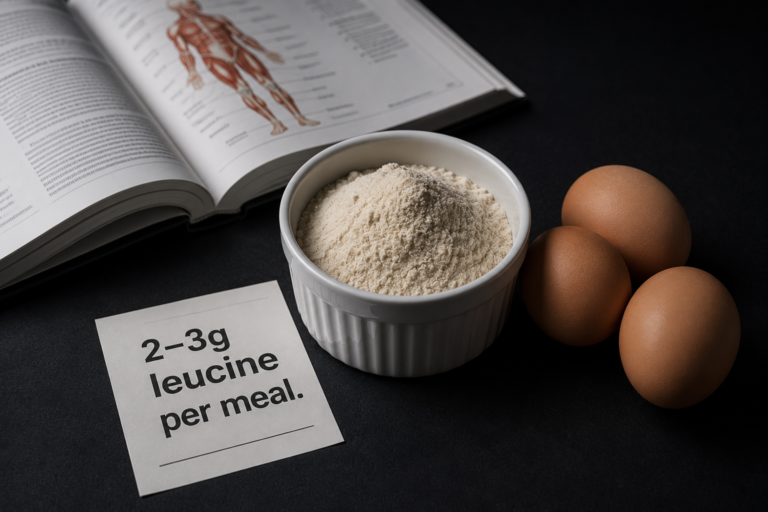
A protein shortfall isn’t neutral for body composition. Muscle protein synthesis requires leucine to trigger mTORC1, the molecular switch that drives synthesis (Churchward-Venne TA et al. Am J Clin Nutr. 2014;99:276-286). Without adequate leucine per meal, roughly 2–3 g, achievable with 25–40 g of high-quality protein, synthesis is submaximally stimulated regardless of yesterday’s intake. Each meal is its own anabolic opportunity. Missed or low-protein meals are missed signals.
What Adequate Protein Actually Looks Like on GLP-1
The target: approximately 0.7–1.0 g of protein per pound of bodyweight per day, or 1.6–2.2 g per kg (Morton RW et al. Br J Sports Med. 2018;52:376-384). For a 200-pound man, that’s 140–200 g per day, staying toward the upper end during active deficit.
Getting there on GLP-1 needs a different approach than standard dietary advice. When food volume tolerance drops, protein density per unit of food becomes the variable that matters.
Liquid protein comes first. A whey shake in water delivers 25–35 g of protein in roughly 12 ounces with minimal gastric volume cost. On low-appetite days, shakes aren’t optional. They’re the floor.
Lean, dense sources beat mixed-macro foods. Chicken breast, canned tuna, egg whites, non-fat Greek yogurt, and white fish all deliver high protein in small volume, with minimal fat or carb co-load.
Protein goes before everything else at every meal. When tolerance is uncertain, especially during dose escalation, the protein component gets eaten first. If nausea ends the meal, the protein still got in.
The drug removes hunger as a feedback signal for adequate intake. Deliberate tracking is the replacement. Without it, the shortfall happens silently and the trial-level lean mass losses become the expected outcome instead of the avoidable one.
The Training Reduction Problem
Nausea, fatigue, and the deficit combine to suppress training volume and intensity in the early months. This matters because resistance training is the primary mechanical signal telling the body to preserve muscle during a deficit. Without it, the body has no reason to prioritize lean mass. It draws from whatever substrate is available.
Most GLP-1 prescribing protocols don’t include a structured training component. The standard consult covers dosing, side effects, and general lifestyle guidance; the training piece is usually absent. That gap is what produced the lean mass outcomes in STEP and SURMOUNT. Participants were losing weight without a signal to keep their muscle.
The three levers, protein, training, and rate of loss, are what close that gap, and the full framework shows how they fit together.
Get the Framework
Download the free GLP-1 Starter Framework, the three-lever system for losing fat without losing muscle. Protein, training, and rate of loss, turned into a protocol you can run from day one.
Download the free GLP-1 Starter Framework →
Want the evidence base behind the reframe, sourced and in one place? That’s GLP-1 & Body Composition: What the Research Actually Says.
FAQ
Does semaglutide cause muscle loss directly?
No. There is no GLP-1 receptor pathway that signals muscle breakdown, and skeletal muscle isn’t a meaningful target tissue for the drug (Drucker, Cell Metabolism, 2016). Semaglutide suppresses appetite, slows gastric emptying, and reduces food reward. The lean mass loss seen in users comes from the caloric deficit those effects create, not from any direct catabolic action on muscle. That’s why protein and training change the outcome.
Why am I losing muscle on Ozempic?
Almost always because the deficit is running without enough protein, without a resistance training stimulus, or too fast, often all three. Ozempic removes hunger, so food intake drops sharply and protein usually drops with it, while nausea and fatigue cut into training. The body then draws energy from both fat and muscle. The drug sets up the conditions; the missing inputs determine how much muscle goes.
How much protein do I need on semaglutide to keep muscle?
Roughly 1.6–2.2 g per kg of bodyweight per day, or about 0.7–1.0 g per pound, with the upper end favored during active weight loss (Morton et al., 2018). For a 200-pound man that’s 140–200 g daily. Just as important as the total is distribution: 25–40 g of high-quality protein per meal hits the leucine threshold that maximally triggers muscle protein synthesis, so spread it across the day rather than backloading it.
Does Ozempic break down muscle for energy?
Not directly. Ozempic itself doesn’t trigger muscle breakdown. But the deficit it creates can. When energy demand outpaces what fat oxidation supplies, the body converts amino acids, including those from muscle, into glucose. That happens faster when the deficit is aggressive and protein is low. Adequate protein, resistance training, and a managed rate of loss keep the body drawing from fat instead.
Will weight training stop muscle loss on GLP-1?
Training is necessary but not sufficient on its own. Resistance exercise provides the mechanical signal that tells the body to preserve muscle, but synthesis is still rate-limited by protein availability. The signal needs the substrate. Paired with adequate protein and a sensible rate of loss, consistent resistance training is the most effective lever for holding lean mass. Alone, it helps but won’t fully protect muscle in a steep deficit.
Nothing on this site constitutes medical advice. I’m not a physician, and this blog documents my own research and experience. Consult a qualified healthcare provider for decisions about medication, dosing, or treatment.
— Ryan Mercer | MetabolicMale.com | ryanmercer@metabolicmale.com
Citations:
Drucker DJ. The Cardiovascular Biology of Glucagon-like Peptide-1. Cell Metabolism. 2016;24:15-30.
Wilding JPH et al. Once-Weekly Semaglutide in Adults with Overweight or Obesity. NEJM. 2021;384:989-1002.
Wilding JPH et al. STEP 1 body composition substudy. Journal of the Endocrine Society. 2021.
Karakasis P, Patoulias D, Fragakis N, Mantzoros CS. Effect of glucagon-like peptide-1 receptor agonists and co-agonists on body composition: Systematic review and network meta-analysis. Metabolism. 2025;164:156113.
Churchward-Venne TA et al. Leucine supplementation of a low-protein mixed macronutrient beverage enhances myofibrillar protein synthesis in young men. Am J Clin Nutr. 2014;99:276-286.
Morton RW et al. A systematic review, meta-analysis and meta-regression of the effect of protein supplementation on resistance training-induced gains in muscle mass. Br J Sports Med. 2018;52:376-384.