The GLP-1 Nutrition Framework: What to Eat on Semaglutide When You’re Trying to Keep Muscle
TL;DR
- What to eat on semaglutide to keep muscle comes down to a framework, not a food list: hit a high protein target, distribute it across the day, manage your deficit, and structure eating around a suppressed appetite.
- Most GLP-1 nutrition advice tells you what to avoid. This tells you what to build: a protein-anchored, scheduled eating structure that works with appetite suppression instead of against it.
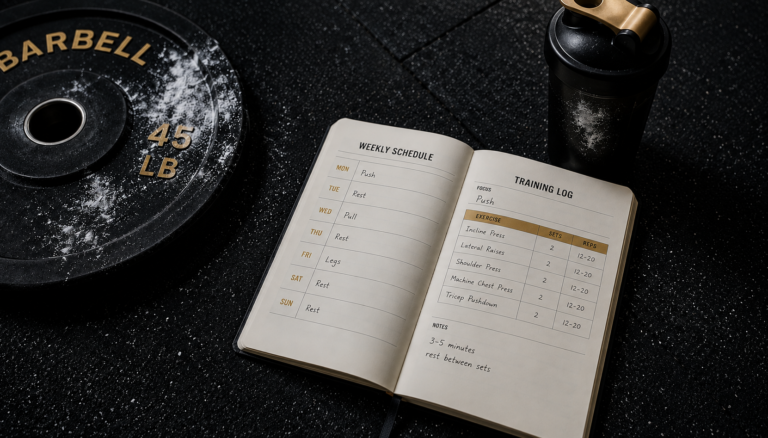
- Nutrition is one of three levers that decide whether you lose fat or lose muscle: protein, resistance training, and rate of weight loss. This is the nutrition lever in full.
- The drug removed your hunger signal. The replacement is structure, and structure is something you can build deliberately.
The problem with every “what to eat on Ozempic” article
Search what to eat on a GLP-1 and you get the same list everywhere: avoid fried foods, skip carbonated drinks, go easy on heavy carbs, eat small meals. None of it is wrong. All of it is beside the point if your goal is to lose fat without losing muscle. That advice is built to manage side effects, not to protect your physique. It tells you what not to eat and leaves you with no structure for what to actually build.
Here is the structure. Eating well on semaglutide while keeping muscle is not about a forbidden-foods list. It is about four things working together: a protein target high enough for a deficit, that protein distributed across the day so it actually stimulates muscle, a deficit managed so it does not get too aggressive, and an eating schedule that replaces the hunger signal the drug switched off. Get those four right and the food choices mostly take care of themselves. This article is the nutrition lever in full, with each piece linked out to its own deep dive.
Download the free GLP-1 Starter Framework: the three-lever system for losing fat without losing muscle.
Why GLP-1 changes everything about how you should eat
The thing that makes GLP-1 nutrition different from every other diet is what the drug does to your hunger. Semaglutide suppresses appetite centrally and slows how fast your stomach empties. That is how it produces weight loss. It is also why the standard rules of eating stop applying. On a normal diet, hunger and fullness give you a usable feedback signal: you feel hungry, you eat; you feel full, you stop. On GLP-1, that signal is not just quieter. It is gone, or close to it, by pharmacological design.
Two things follow. First, you can no longer eat by appetite, because appetite is no longer reporting your actual needs. Second, you will under-eat without noticing (protein especially) because nothing is prompting you to eat. The fix for both is the same: replace the missing hunger signal with deliberate structure. Scheduled eating instead of intuitive eating, and tracked protein instead of “I think I had enough.” The rest of this framework is what that structure looks like.
When I built my own protocol before starting, I treated the whole thing as a tracked system from day one rather than something to feel my way through. Precisely because I knew the appetite suppression would make ad-hoc eating drift toward under-consumption. Every part of what follows I ran as a deliberate target with a floor for bad days, not as a set of rules I hoped to follow.
The protein floor: why 1.6–2.0 g/kg is non-negotiable
Protein is the anabolic signal the drug does not provide. Semaglutide manages your appetite; it does nothing to protect lean tissue. In a caloric deficit your body looks for tissue to break down, and without enough dietary protein plus a training stimulus, some of that tissue is muscle.
The research-supported target for preserving lean mass while training is 1.6–2.0 g of protein per kilogram of bodyweight, from a 2018 meta-analysis by Morton and colleagues (British Journal of Sports Medicine, 2018;52:376–384). The ISSN position stand (Jager et al., J Int Soc Sports Nutr, 2017;14:20) lands in the same range, 1.4–2.0 g/kg for exercising adults. For a GLP-1 user in a deficit, treat 2.0 g/kg as the target and 1.6 g/kg as the floor you do not drop below. This is roughly double the 0.8 g/kg RDA, which was set to prevent deficiency in sedentary, weight-stable people, not to protect muscle during weight loss.
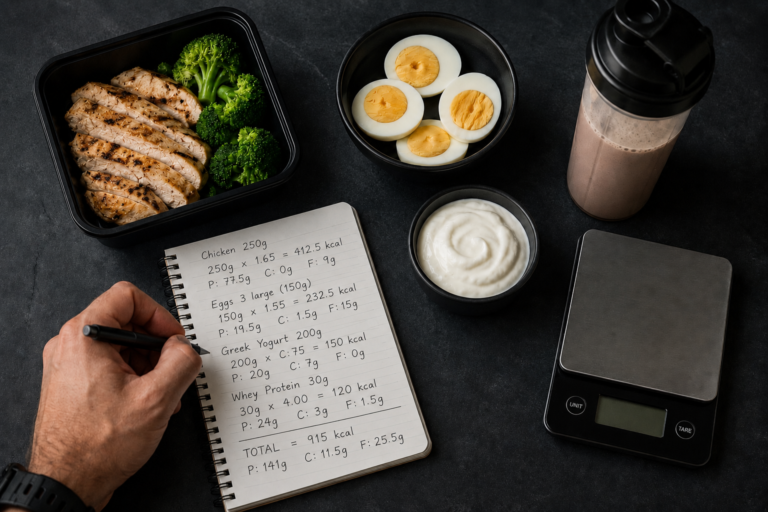
The stakes are not hypothetical. On average, about a quarter of the weight lost on GLP-1 medications comes from lean mass, per a 2025 pooled analysis of 22 randomized trials by Karakasis and colleagues (Metabolism, 2025;164:156113). Protein and training are the levers that move that fraction in your favor. The full case for the number, including the calculation, is in how much protein you actually need on semaglutide, and the worked walkthrough is in how much protein on Ozempic, Wegovy, or Mounjaro.
The leucine problem: per-meal distribution matters
Hitting your daily protein total is necessary but not sufficient. Muscle protein synthesis is triggered meal by meal, and each meal needs a minimum dose of the amino acid leucine (roughly 2–3 g, about what is in 25–35 g of a quality protein) to switch the pathway on (Norton & Layman, J Nutr, 2006;136:533S–537S). Spread 150 g of protein across two big meals and you stimulate muscle fewer times than the same 150 g across four meals.
GLP-1 users are uniquely prone to getting this wrong, because suppressed appetite collapses eating into one or two large meals, usually a light morning, a skipped lunch, and most of the day’s protein at dinner. That pattern can hit the daily total while missing most of the day’s synthesis windows. The fix costs nothing: spread the same protein across three or four threshold-clearing meals. The full mechanism is in the leucine threshold and why your daily total isn’t enough.
Calorie floor vs. calorie target
Most diet advice warns against eating too much. On GLP-1, the more common failure is eating too little. The drug suppresses appetite so effectively that many users drift to 1,000–1,200 calories a day without trying, and a deficit that aggressive accelerates muscle loss. The body cannot spare lean tissue when energy is that scarce, no matter how much protein you eat.
This is why you need a calorie floor, not just a calorie target. The target is the deficit you are aiming for; the floor is the line below which the deficit becomes self-defeating. Rate of weight loss is the third lever of the framework for exactly this reason: lose too fast and you lose more of it as muscle. Research in lean athletes found that a faster rate of loss cost more lean mass than a slower one (Garthe et al., Int J Sport Nutr Exerc Metab, 2011;21(2):97–104). The deficit-management logic in full is in rate of weight loss on GLP-1.
Meal structure on suppressed appetite
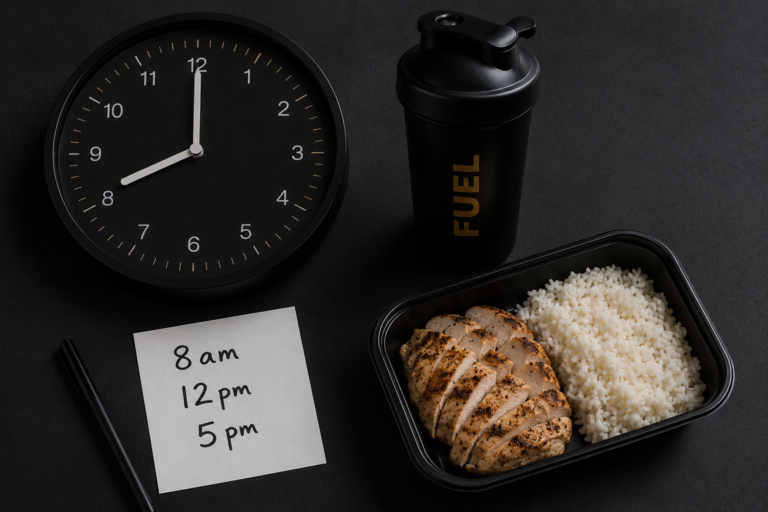
Because the hunger signal is gone, you eat by the clock instead of by appetite. Fixed meal windows (say 8am, 12pm, 5pm, with an optional evening feeding) each anchored by a protein floor, hit whether or not you feel hungry. The trigger is the time, not the appetite. This solves two problems at once: it ensures you eat enough, and it naturally distributes your protein for the leucine threshold. The full case against intuitive eating on GLP-1, and how to build the schedule, is in eating by the clock on GLP-1.
Distribution within the day matters too. I ran a 200 g daily protein target and front-loaded it (hitting roughly half by lunch) so the back half of the day was a manageable top-up rather than a crushing end-of-day scramble against a dead appetite. On training days I clustered most of my carbohydrate around the workout rather than spreading it evenly. The 200 g figure was specific to my bodyweight, not a recommendation; your number comes from the calculation. But the front-load principle travels: get protein in early while tolerance is best, because it only gets harder as the day goes on.
The foods that work when volume is your enemy
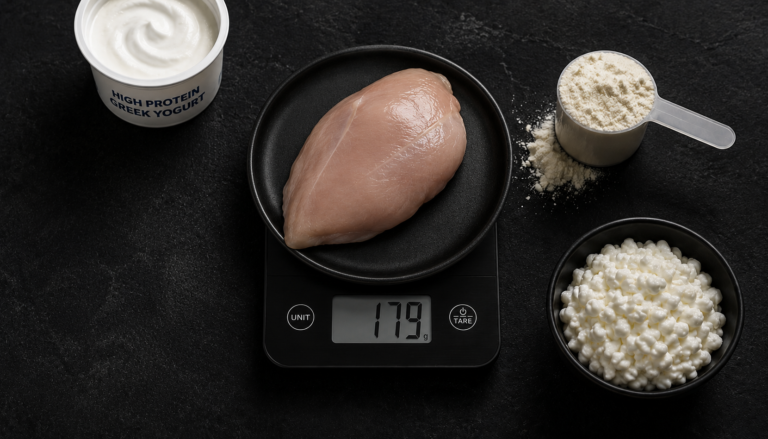
On a suppressed appetite, your binding constraint is stomach volume, so the right foods are the ones that pack the most protein into the least space. Rank by protein density (protein per gram of food) not protein per serving. Whey isolate, Greek yogurt, egg whites, and chicken breast sit at the top; fibrous vegetables and bulky grains, however healthy, work against you when they crowd out protein you had no room for. The full ranking is in protein-dense foods that actually work on GLP-1.
Carbohydrate has a place too: this is not a keto protocol. Cutting carbs to zero while training in a deficit degrades the workouts that protect your muscle. The move is timing, not elimination: concentrate carbs around training, keep them lower elsewhere. The reasoning is in carbs on semaglutide.
Pre- and post-workout nutrition basics
Training is the second lever, and you have to fuel it even when you are not hungry. The working protocol is 20–30 g of protein plus 20–40 g of easy carbohydrate 60–90 minutes before lifting, then 20–40 g of leucine-rich protein within about two hours after. On a suppressed appetite, a small, dense, part-liquid pre-workout feeding is what makes this tolerable. The full peri-workout protocol is in pre- and post-workout nutrition on semaglutide.
Injection day: the week’s hardest nutrition day
Appetite bottoms out 12–72 hours after your injection, which makes injection day the hardest day to hit your protein, and therefore the day muscle loss is most likely to start if you let intake fall to near zero. The protocol is to front-load protein before symptoms set in, shift to liquid and soft foods as the appetite window narrows, and hold a non-negotiable protein floor through the worst of it. The full injection-day protocol, including how injection timing changes things, is in injection day nutrition.
Liquid protein is the tool that holds the floor on the hard days, because it bypasses the fullness signal that blocks solid food. The reason a shake is a clinical tool on GLP-1, not just convenience, is in the protein shake strategy for GLP-1 users.
What the Tier 2A framework covers that this article does not
This article gives you the structure: the four pieces and how they fit. What it does not give you is the week-by-week implementation, and on a suppressed appetite, implementation is where most people fall down, because knowing the target and hitting it every day are different problems.
The GLP-1 Nutrition Planning Framework picks up there. It turns this framework into a system you run: a 12-week tracking spreadsheet for logging protein and calories against your floor, a weekly planning structure so you are not deciding what to eat on a dead appetite, the injection-day protocol in full detail, and the deficit-management math worked out. This article tells you what to build. The framework is the tool that builds it.
Key Takeaway
Eating on semaglutide to keep muscle is a framework, not a food list. Hit a protein target of 1.6–2.0 g/kg with a floor you defend daily. Distribute that protein across three or four meals so each clears the leucine threshold. Manage your deficit with a calorie floor, not just a target, because eating too little costs you muscle. And replace the hunger signal the drug switched off with a fixed eating schedule built around protein-dense foods and timed carbohydrate. The drug created the conditions for weight loss. Whether that weight comes off as fat or as muscle is decided by what you build on top of it, and the nutrition lever is the one you have the most direct control over.
Download the free GLP-1 Starter Framework, the three-lever system for losing fat without losing muscle.
The GLP-1 Nutrition Planning Framework ($17) is the implementation system behind this article: protein targets, deficit management, injection-day adjustments, and a 12-week tracking spreadsheet for logging it all.
FAQ
What should I eat on semaglutide to keep muscle?
Build four things: a protein target of 1.6–2.0 g per kg of bodyweight, that protein spread across three or four meals to trigger muscle protein synthesis at each, a managed deficit with a calorie floor so you do not eat too little, and a fixed eating schedule that replaces the hunger signal the drug suppresses. Anchor meals with protein-dense foods and time carbohydrate around training.
How do I avoid losing muscle on Ozempic or Wegovy?
Three levers control it: enough protein (1.6–2.0 g/kg), resistance training to signal your body to keep muscle, and a controlled rate of weight loss so the deficit is not so aggressive it strips lean tissue. On average about a quarter of GLP-1 weight loss is lean mass (Karakasis et al., 2025), and these three levers move that fraction in your favor. Nutrition supplies two of the three.
Why am I not hungry on semaglutide, and is that a problem?
The medication suppresses appetite centrally and slows gastric emptying, that is how it works. It becomes a problem when you eat by hunger, because the absence of a hunger cue means you under-eat protein and calories without noticing. The solution is eating on a fixed schedule rather than by appetite, ensuring consistent protein intake even when nothing prompts you to eat.
How much protein do I need on a GLP-1 medication?
Aim for about 2.0 g per kg of bodyweight, with 1.6 g/kg as your floor. At 180 lbs (82 kg) that is roughly 164 g target and 131 g floor, about double the 0.8 g/kg RDA, which was designed for sedentary people, not for someone in a deficit preserving muscle. Recalculate every 15–20 lbs as your weight drops.
Is keto good on semaglutide?
Not for someone resistance training to keep muscle. The drug already enforces a deficit, and stacking carbohydrate elimination on top degrades the training that protects your muscle. Carbohydrate fuels your sessions and supports recovery. The better approach is timing (concentrating carbs around training and keeping them lower elsewhere) rather than eliminating them. Lower-carb can suit sedentary users or those managing blood glucose with a physician.
What do I eat on injection day when I feel too sick to eat?
Front-load protein before symptoms peak, then drop to floor mode: liquid protein and soft, dense foods like shakes, Greek yogurt, and soft eggs, eaten on schedule rather than by appetite. Hold a non-negotiable protein floor even if you cannot hit your full target. Never let the day fall to near-zero intake. A missed protein day is when muscle loss is most likely to begin.
Nothing on this site constitutes medical advice. I’m not a physician, and this blog documents my own research and experience. Consult a qualified healthcare provider for decisions about medication, dosing, or treatment.
Ryan Mercer | MetabolicMale.com | ryanmercer@metabolicmale.com
References
Citations:
- Morton RW et al. A systematic review, meta-analysis and meta-regression of the effect of protein supplementation on resistance training-induced gains in muscle mass and strength in healthy adults. Br J Sports Med. 2018;52:376–384.
- Jager R et al. International Society of Sports Nutrition Position Stand: protein and exercise. J Int Soc Sports Nutr. 2017;14:20.
- Norton LE, Layman DK. Leucine regulates translation initiation of protein synthesis in skeletal muscle after exercise. J Nutr. 2006;136:533S–537S.
- Karakasis P et al. Metabolism. 2025;164:156113.
- Garthe I et al. Effect of two different weight-loss rates on body composition and strength and power-related performance in elite athletes. Int J Sport Nutr Exerc Metab. 2011;21(2):97–104.