Ozempic vs Wegovy vs Mounjaro: What’s Really Different Across 4 Brand Names
TL;DR
- Ozempic and Wegovy are the same drug (semaglutide). Mounjaro and Zepbound are the same drug (tirzepatide). The brand name mostly signals what it’s approved to treat.
- All four are GLP-1 medications: engineered versions of a hormone your gut already makes.
- Tirzepatide hits two receptors instead of one, which is why it tends to produce more weight loss than semaglutide.
- None of them protect muscle. That part is on you, and it’s the whole reason this site exists.
Ozempic and Wegovy are the same drug: semaglutide. Mounjaro and Zepbound are the same drug: tirzepatide. The difference between the brand names is mostly what they’re approved to treat and the dose, not the molecule.
All four are GLP-1 medications: engineered versions of a hormone your body already makes, but modified to last far longer and activate the receptor more consistently. The confusing part is that the brand names make the category look more complicated than it is.
Download the free GLP-1 Starter Framework, the three-lever system for losing fat without losing muscle.
Ozempic vs Wegovy: The Brand Name Breakdown
| Drug | Brand Name (Diabetes) | Brand Name (Weight Loss) | Mechanism |
|---|---|---|---|
| Semaglutide | Ozempic | Wegovy | GLP-1 agonist |
| Tirzepatide | Mounjaro | Zepbound | GLP-1 + GIP dual agonist |
| Liraglutide | Victoza | Saxenda | GLP-1 agonist (older generation) |
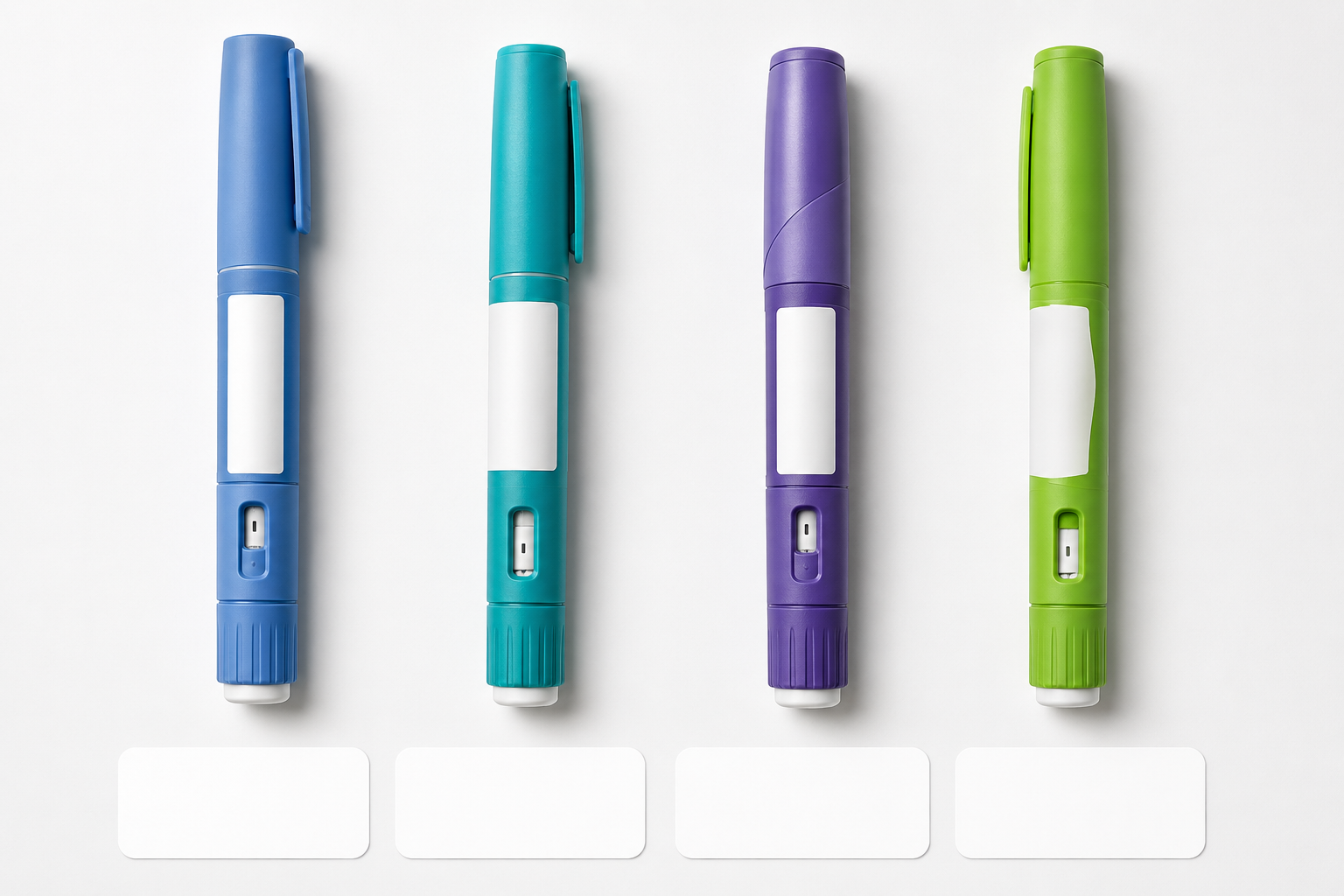
Same molecule, different brand names depending on what it’s approved to treat. Ozempic and Wegovy are both semaglutide. Mounjaro and Zepbound are both tirzepatide. The dose and indication differ; the drug doesn’t.
The Hormone Underneath All of Them
Every time you eat, your small intestine releases glucagon-like peptide-1: GLP-1. It’s secreted by L-cells in your gut lining, and its job is to manage the response to food. Your natural GLP-1 does three things: it signals the pancreas to release insulin, but only when blood sugar is elevated, which is why it doesn’t cause hypoglycemia on its own; it slows gastric emptying, so food stays in your stomach longer and you feel full; and it signals the hypothalamus that you’ve eaten and don’t need more.
The problem with your own GLP-1 is that it’s destroyed almost immediately. The enzyme DPP-4 breaks it down within minutes. It works, but briefly.
What the Medications Do Differently
GLP-1 receptor agonists do the same thing your natural GLP-1 does. They bind to GLP-1 receptors throughout the body, but they’re engineered to resist that rapid breakdown. Semaglutide (Ozempic, Wegovy) has a half-life of roughly seven days, so one injection a week maintains a sustained level of receptor activation your own hormone never reaches.
Tirzepatide (Mounjaro, Zepbound) goes further. It activates both GLP-1 receptors and GIP receptors, a second gut hormone involved in metabolic regulation. That second receptor is the mechanistic reason tirzepatide tends to outperform semaglutide on weight loss: GIP appears to add a parallel signal that supports appetite regulation and fat metabolism, stacking on top of the GLP-1 effect rather than duplicating it. The practical result shows up in the trial data, below.
Semaglutide vs. Tirzepatide: What the Weight Loss Data Shows
The STEP program for semaglutide showed mean weight loss of 14.9% at 68 weeks in adults with overweight or obesity (Wilding et al., New England Journal of Medicine, 2021). Tirzepatide went further in SURMOUNT-1, with mean weight loss of 20.9% at the highest dose over 72 weeks (Jastreboff et al., New England Journal of Medicine, 2022).
That difference matters, but not because one drug automatically produces better body composition. Greater total weight loss usually means a larger deficit, and a larger deficit raises the stakes on protein, resistance training, and rate-of-loss management.
If you want the trial data behind this, GLP-1 & Body Composition covers what the STEP and SURMOUNT trials measured, why lean mass fractions get misread, and how to interpret the evidence without scare framing.
Or if you want the most important question next: Does Ozempic Cause Muscle Loss? The Research-Based Answer →
What GLP-1 Medications Don’t Do
Here’s the gap nobody hands you with the prescription. None of these drugs send an anabolic signal to muscle. None of them preferentially burn fat over lean tissue. They’re appetite and satiety tools, powerful ones, and nothing more. They create the deficit; they don’t decide whether that deficit comes out of fat or muscle.
That decision is governed by three things you control: protein intake, resistance training, and how fast you lose weight. This site calls them the three levers, and they’re the entire reason a body composition–focused approach to GLP-1 exists. The drug is the easy part. Keeping your muscle while the fat comes off is the part worth getting right.
Or go straight to the practical: How Much Protein on Ozempic, Wegovy, or Mounjaro → for your daily target, and Ozempic Nausea: What to Eat → for the worst days.
Or grab the free Starter Framework here →, where the three levers become a usable protocol.
If you want the trial data behind this, GLP-1 & Body Composition covers what the STEP and SURMOUNT trials measured, why lean mass fractions get misread, and how to interpret the evidence without scare framing.
FAQ
Is Ozempic the same as Wegovy?
Yes. Both are semaglutide, the same active molecule. Ozempic is approved for type 2 diabetes; Wegovy is the same drug approved at higher doses for weight management. The brand name reflects the approved use and dosing, not a different medication. Anything written about semaglutide’s mechanism or effects applies to both.
Which is stronger, Mounjaro or Ozempic?
In trial data, tirzepatide (Mounjaro, Zepbound) produces greater average weight loss than semaglutide (Ozempic, Wegovy): roughly 20.9% versus 14.9% at the highest doses in their respective pivotal trials. That’s attributed to tirzepatide acting on two receptors (GLP-1 and GIP) rather than one. “Stronger” for weight loss, though, also means a faster deficit and more attention needed on muscle.
Can I take Ozempic if I don’t have diabetes?
Ozempic is FDA-approved for type 2 diabetes, but doctors prescribe it off-label for weight loss. Wegovy is the same molecule approved specifically for weight management in people without diabetes who meet certain criteria. Whether either is appropriate for you is a decision for your prescriber based on your health profile.
Will I lose muscle on GLP-1 medications?
Some lean mass loss is normal during any weight loss, and GLP-1 drugs are no exception. But the drug doesn’t cause muscle loss directly: the caloric deficit does. With adequate protein and resistance training, most of what you lose comes from fat. Manage protein, training, and rate of loss, and muscle loss is largely preventable.
I started researching both drugs before my first injection because the prescribing conversation did not answer the question I cared about most: how to lose fat without giving up muscle. That is where the three-lever framework came from. The medication creates the deficit. The framework manages what that deficit is made of.
Nothing on this site constitutes medical advice. I’m not a physician, and this blog documents my own research and experience. Consult a qualified healthcare provider for decisions about medication, dosing, or treatment.
– Ryan Mercer | MetabolicMale.com | ryanmercer@metabolicmale.com
References
- Wilding JPH, Batterham RL, Calanna S, et al. Once-weekly semaglutide in adults with overweight or obesity. New England Journal of Medicine. 2021;384:989-1002.
- Jastreboff AM, Aronne LJ, Ahmad NN, et al. Tirzepatide once weekly for the treatment of obesity. New England Journal of Medicine. 2022;387:205-216.
- Holst JJ. The physiology of glucagon-like peptide 1. Physiological Reviews. 2007;87:1409-1439.
- Drucker DJ. The cardiovascular biology of glucagon-like peptide-1. Cell Metabolism. 2016;24:15-30.