The Leucine Threshold: Why Your Daily Protein Total Isn’t Enough on GLP-1
TL;DR
- The leucine threshold is the reason hitting your daily protein number on GLP-1 can still leave muscle on the table. Each meal needs roughly 2–3 g of leucine to switch muscle protein synthesis on.
- Daily protein total is a necessary condition, not a sufficient one. 150 g spread across two big meals stimulates muscle less effectively than the same 150 g across three or four.
- GLP-1 users are uniquely prone to this because appetite suppression makes frequent, structured eating feel unnecessary, so protein gets crammed into one or two sittings.
- Fixing distribution costs nothing extra. You eat the same protein; you just spread it so each meal clears the threshold.
Why your protein math can be right and your result still wrong
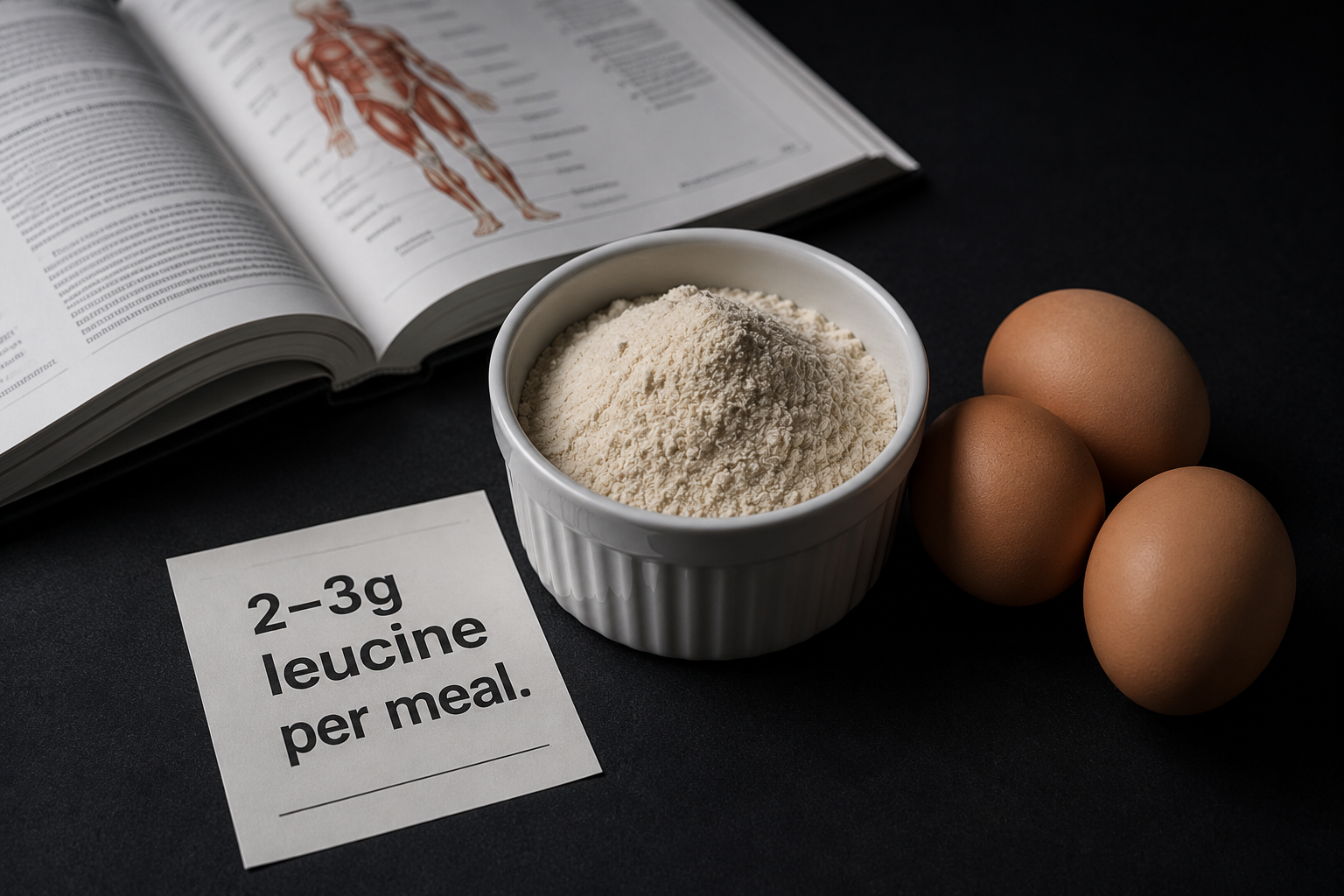
Here is the mechanism most GLP-1 nutrition advice skips: muscle protein synthesis is not driven by your daily protein total alone. It is driven, meal by meal, by whether each feeding delivers enough of the amino acid leucine to trigger the signaling pathway that builds and retains muscle. That pathway is called mTORC1, and it behaves like a switch with a minimum input. Below the threshold, the response is muted. At or above it, the switch flips and synthesis ramps. Norton and Layman described this leucine-trigger model in J Nutr (2006;136:533S–537S), placing the per-meal threshold at roughly 2–3 g of leucine, about the amount in 25–30 g of a high-quality protein like whey, eggs, or chicken.
The practical implication: you can hit 150 g of protein for the day, feel like you nailed it, and still get a suboptimal muscle-preservation result because most of that protein arrived in one or two large meals with long gaps in between.
Download the free GLP-1 Starter Framework: the three-lever system for losing fat without losing muscle.
What mTORC1 is and why it controls muscle protein synthesis
Here is what matters without turning this into a biochemistry lecture. mTORC1 is a molecular complex inside muscle cells that helps regulate protein synthesis. When it is active, the cell builds and repairs muscle protein. When it is quiet, that machinery idles. Several inputs activate it, but the one you control directly through food is amino acid availability. Leucine is the amino acid that does most of the signaling work. In this context, leucine is less a building block and more a key. It tells the cell that protein has arrived and it is time to build.
In a caloric deficit, this matters more, not less. A deficit raises the threshold for a robust synthesis response, so getting a clean leucine signal at each meal is how you keep the muscle-retention machinery firing on a body that is otherwise being told to conserve and break down. This is why daily total is the wrong unit of measurement. The body resets the synthesis question at every meal. Each feeding is a separate opportunity to flip the switch, or to miss it.
The leucine threshold: what it takes to actually trigger MPS
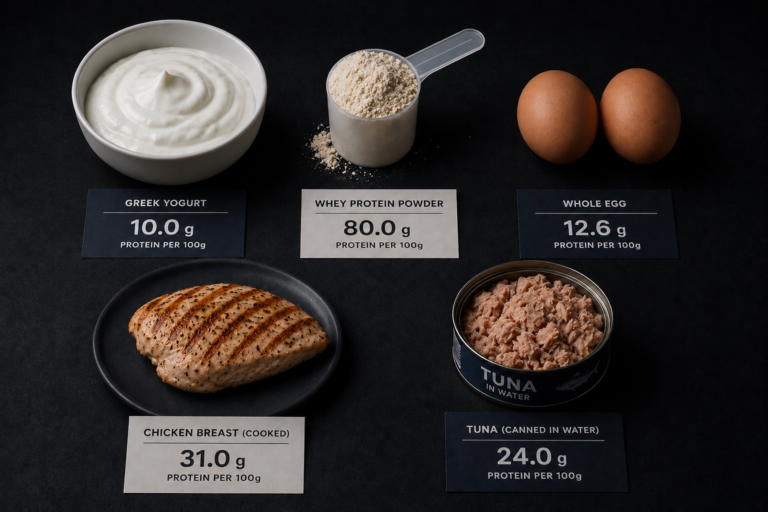
The working number is about 2–3 g of leucine per meal. You do not need to count leucine grams directly; you need to know which foods clear the bar in a reasonable portion. As a rule of thumb, a meal anchored by 25–35 g of a leucine-rich animal protein clears the threshold. The richest sources per gram of protein are whey, eggs, dairy, chicken, and lean beef. Plant proteins generally carry less leucine per gram, which is why a plant-based meal often needs a larger portion (or a leucine-dense addition) to hit the same trigger.
Churchward-Venne and colleagues showed that adding leucine or essential amino acids to a suboptimal protein dose can increase myofibrillar protein synthesis after resistance exercise (J Physiol, 2012;590(11):2751-2765). That supports the practical point here: leucine availability matters at the meal level. It does not mean leucine powder is the main solution. The main solution is distributing high-quality protein across the day so each meal clears the threshold. The anchor citation for the threshold itself remains Norton and Layman (2006).
The takeaway is portion-shaped, not gram-counted: build every meal around a protein source big enough to clear roughly 2–3 g of leucine, and you stop worrying about the threshold because you are clearing it by default.
The GLP-1 problem: why appetite suppression breaks meal distribution
This is where GLP-1 users get into trouble that a normal dieter does not. The drug suppresses appetite at the hypothalamic level, which means you do not feel hungry, which means structured, frequent eating feels pointless. The body is not asking for food, so you do not provide it. Until late in the day when you realize you have barely eaten and you compensate with one large meal.
I call this the two-meal trap, and it is the default failure pattern on GLP-1. A user grazes a little in the morning, skips a real lunch because nothing sounds good, then eats most of the day’s protein at dinner because that is the one window appetite cooperates. Daily total might even look fine. But two of the day’s three or four potential synthesis windows got missed entirely, and the muscle-retention signal those meals would have sent never fired.
The fix is to stop letting hunger schedule your eating, because on this drug hunger has been pharmacologically switched off and can no longer do that job. Eating by the clock instead of by appetite is the structural solution, covered in full in eating by the clock on GLP-1.
When I built my own protocol, the leucine research is what changed my meal structure before I ever took a dose. I had assumed that as long as the daily protein total was there, timing was a detail. Reading the per-meal synthesis literature flipped that assumption. I restructured from one big post-gym protein load into three distributed, protein-anchored meals so that each one would clear the threshold on its own. It was a planning decision made on paper, ahead of time, precisely because I knew the appetite suppression would make ad-hoc eating drift toward the two-meal trap. Designing the distribution in advance was the only way to keep it from collapsing once the drug removed the hunger cue that would normally have spaced things out.
What an optimally distributed day looks like
Three to four protein-anchored meals, each clearing the leucine threshold, spaced across waking hours:
- Meal 1 (morning): 3 eggs + Greek yogurt: clears threshold
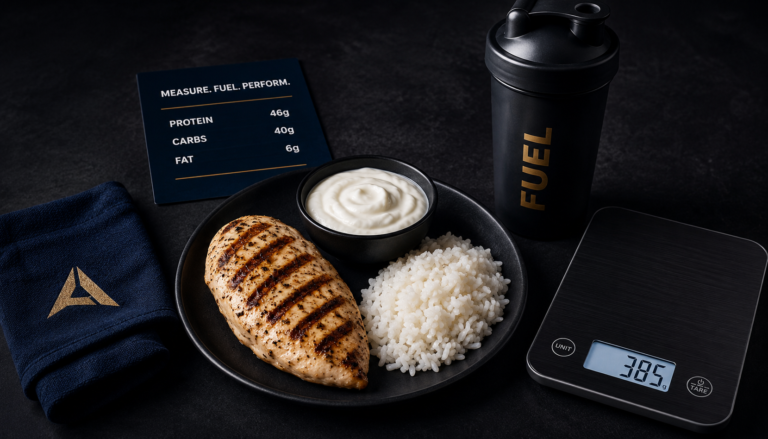
- Meal 2 (midday): 5 oz chicken or a 1–2 scoop whey shake: clears threshold
- Meal 3 (evening): 5 oz beef, salmon, or equivalent: clears threshold
- Optional Meal 4: cottage cheese or casein before bed: clears threshold
Four windows, four times the synthesis machinery gets switched on. Compare that to the same protein total delivered in two meals: two windows, two activations, and a long catabolic stretch in between where nothing tells the body to hold its muscle.
The sources with the highest leucine-per-gram ratio
If you remember one ranking, remember this one. The most leucine-efficient sources (the ones that clear the threshold in the smallest portion, which is exactly what you want on a suppressed appetite) are whey protein, eggs, Greek yogurt, chicken breast, and lean beef. Whey sits at the top because it is both high in leucine and rapidly digested, which produces a sharp synthesis spike. That is also why a whey shake is the most reliable threshold-clearing tool when solid food is the bottleneck. The full food hierarchy, ranked for the GLP-1 volume constraint, is in protein-dense foods that actually work on GLP-1.
Key Takeaway
Your daily protein total gets you in the game; per-meal leucine distribution determines whether you win it. Each meal needs roughly 2–3 g of leucine (about 25–35 g of a quality animal protein) to flip the muscle protein synthesis switch. GLP-1 users miss this because suppressed appetite collapses their eating into one or two big meals, leaving most of the day’s synthesis windows empty. Spread the same protein across three or four threshold-clearing meals and you stimulate muscle retention several times a day instead of once or twice, at no extra calorie or protein cost. Distribution is free. Use it.
Download the free GLP-1 Starter Framework: the three-lever system for losing fat without losing muscle.
The GLP-1 Nutrition Planning Framework ($17) covers protein targets, deficit management on suppressed appetite, injection day adjustments, and a 12-week tracking spreadsheet for logging it all.
FAQ
How much leucine do I need per meal on GLP-1?
Roughly 2–3 g of leucine per meal to reliably trigger muscle protein synthesis (Norton & Layman, 2006). You do not need to count it directly. A meal anchored by 25–35 g of a quality animal protein such as whey, eggs, chicken, or beef clears the threshold. Plant-based meals usually need a larger portion or an added leucine source to reach the same trigger.
Is total daily protein or per-meal protein more important?
Both matter, in sequence. Hit your daily total first, that is the foundation. Then distribute it so each meal clears the leucine threshold. Total protein with poor distribution underperforms the same total spread across three or four meals, because muscle protein synthesis resets at each feeding and each meal is a separate chance to stimulate it.
Why do GLP-1 users struggle with protein distribution?
Because the medication suppresses appetite, so the hunger cue that would normally space out eating disappears. Users tend to graze lightly and then load most of their protein into one evening meal when appetite briefly cooperates. This “two-meal trap” can hit the daily total while missing most of the day’s synthesis windows.
Does it matter what time I eat protein on semaglutide?
Spacing matters more than clock time. Aim for a threshold-clearing protein dose every 3–5 hours across your waking window rather than one or two large loads. A pre-bed casein or cottage cheese feeding can add a final synthesis window overnight, which is useful when daytime appetite is low and meals are small.
Nothing on this site constitutes medical advice. I’m not a physician, and this blog documents my own research and experience. Consult a qualified healthcare provider for decisions about medication, dosing, or treatment.
Ryan Mercer | MetabolicMale.com | ryanmercer@metabolicmale.com
Citations:
- Norton LE, Layman DK. Leucine regulates translation initiation of protein synthesis in skeletal muscle after exercise. J Nutr. 2006;136:533S–537S.
- Jager R et al. International Society of Sports Nutrition Position Stand: protein and exercise. J Int Soc Sports Nutr. 2017;14:20.
- Stokes T et al. Recent perspectives regarding the role of dietary protein for the promotion of muscle hypertrophy with resistance exercise training. Nutrients. 2018;10:180.
- Churchward-Venne TA et al. Supplementation of a suboptimal protein dose with leucine or essential amino acids: effects on myofibrillar protein synthesis at rest and following resistance exercise in men. J Physiol. 2012;590(11):2751–2765.