How Much Protein Do You Actually Need on Semaglutide? (The 2.0g/kg Case)
TL;DR
- Your protein target on semaglutide is roughly 2.0 g per kg of bodyweight, about double the standard 0.8 g/kg recommendation, and the gap is the single most common reason GLP-1 users lose muscle instead of just fat.
- The 0.8 g/kg RDA was set to prevent deficiency in sedentary people who are not losing weight. It was never meant for someone in a sustained caloric deficit trying to hold onto lean mass.
- A man at 185 lbs needs roughly 168 g of protein a day at the 2.0 g/kg target, with a floor around 134 g (1.6 g/kg). Most GLP-1 users are landing closer to 80–100 g without realizing it.
- Hitting the number on suppressed appetite is a logistics problem, not a knowledge problem, and it is solvable.
The number most semaglutide users are missing by a third
Here is the answer up front: if you are losing weight on semaglutide and you care about keeping muscle, aim for about 2.0 g of protein per kilogram of bodyweight per day, with 1.6 g/kg as the floor you do not drop below. That range comes from a 2018 meta-analysis by Morton and colleagues in the British Journal of Sports Medicine (2018;52:376–384), which pooled resistance-training studies and found protein intakes up to roughly 2.0 g/kg supported lean mass and strength, with diminishing returns above that. The International Society of Sports Nutrition position stand (Jager et al., J Int Soc Sports Nutr, 2017;14:20) lands in the same neighborhood: 1.4–2.0 g/kg for exercising adults.
The problem is that almost nobody on a GLP-1 medication is eating that much, and most of them think they are.
Download the free GLP-1 Starter Framework, the three-lever system for losing fat without losing muscle.
Why the standard protein advice does not apply on GLP-1
The 0.8 g/kg figure you have seen on government nutrition sites is the Recommended Dietary Allowance. It exists to keep a sedentary adult out of protein deficiency, to prevent the body from cannibalizing its own tissue under normal conditions. That is the entire design brief for the number. It assumes you are weight-stable and not training hard.
A GLP-1 user is neither. You are in a caloric deficit, often a large one, and a deficit is a catabolic environment. The body has less incoming energy than it needs, so it looks for tissue to break down. Fat is the target you want. Muscle is the target you do not, and in a deficit, muscle is on the table unless two signals tell the body to keep it: a mechanical stimulus from resistance training, and a steady supply of dietary protein. Protein is the anabolic signal the drug does not provide. Semaglutide manages your appetite and blood sugar. It does nothing to protect lean tissue. That job is yours.
There is a second wrinkle specific to a deficit. As you eat less, the efficiency with which your body uses protein for muscle maintenance drops, a state sometimes described as anabolic resistance. The practical consequence is that the harder you are dieting, the more protein you need to achieve the same muscle-sparing effect, not less. This is why the athlete-focused literature pushes higher still: Helms and colleagues (J Int Soc Sports Nutr, 2014;11:20) recommend 2.3–3.1 g/kg of lean body mass for lean athletes in aggressive deficits. For most GLP-1 users who are not competition-lean, the 1.6–2.0 g/kg of total bodyweight range is the right operating zone.
What the research says: 1.6–2.0 g/kg for adults in a deficit
The Morton meta-analysis is the anchor citation because it is large, it is recent, and it is specifically about the protein intake that supports lean mass during training. The headline finding: benefits to lean mass and strength accrued up to about 1.6 g/kg, with the upper credible bound near 2.0 g/kg. Above that, the curve flattens. More protein is not harmful, but it stops buying you additional muscle protection.
Where should a GLP-1 user sit in that range? Toward the top. You are not a weight-stable lifter nudging body composition at maintenance calories. You are in a deficit, which pushes the requirement up, so 2.0 g/kg is the target and 1.6 g/kg is the line you treat as non-negotiable on a bad day. The deficit is also why this matters more for you than for the average gym-goer: roughly a quarter of the weight lost on GLP-1 medications comes from lean mass on average, per a 2025 pooled analysis of 22 randomized trials by Karakasis and colleagues (Metabolism, 2025;164:156113). Protein and training are the two levers that move that fraction in your favor.
The calculation: how to find your number
The math is simple. Take your bodyweight in pounds, divide by 2.2 to get kilograms, then multiply by 2.0 for your target and 1.6 for your floor.
A worked example at 185 lbs:
- 185 ÷ 2.2 = 84 kg
- 84 × 2.0 = 168 g protein per day (target)
- 84 × 1.6 = 134 g protein per day (floor)
Run your own number once and write it down. That single figure governs every food decision you make for the rest of your time on the medication. For a full walkthrough including how to adjust as your weight drops, the protein calculation guide covers it: how much protein on Ozempic, Wegovy, or Mounjaro.
One adjustment worth making as you lose weight: recalculate every 15–20 lbs. Your target moves with your bodyweight, so the 168 g that was right at 185 lbs becomes about 150 g at 165 lbs. Riding the same number down with your scale weight keeps the deficit-adjusted requirement honest.
What 160–170 g of protein actually looks like in a day
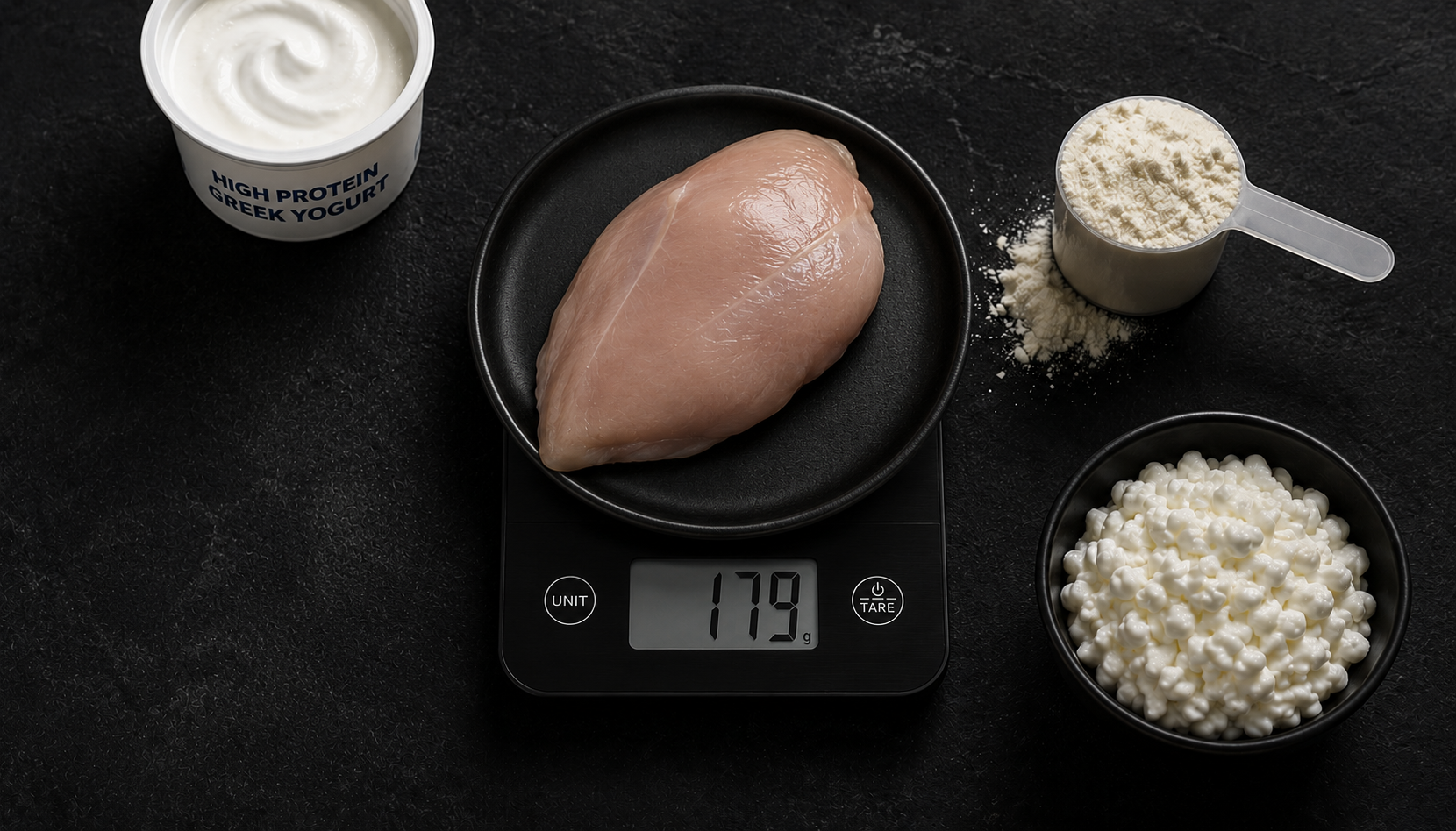
The objection I hear most is that this is impossible to hit when the drug has killed your appetite. It is not impossible. It is a scheduling and density problem, and once you treat it that way it becomes tractable. A representative day:
- Breakfast: 3 eggs + a cup of Greek yogurt: ~35 g
- Lunch: 5 oz chicken breast: ~40 g
- Afternoon: protein shake (1 scoop whey): ~25 g
- Dinner: 5 oz lean beef or salmon: ~40 g
- Evening: cottage cheese or a second shake: ~25 g
That is roughly 165 g across five small touches, none of which requires a large-volume meal. The trick is distribution: small, protein-dense feedings spaced through the day rather than two big plates you cannot finish.
I ran a 200 g daily protein target through my whole protocol, and the end of the day was where it routinely went sideways. On the nights when solid food had stopped sounding appealing (which on a GLP-1 is most nights) closing the gap meant a protein shake with three scoops late in the evening to recover whatever I was short. It was not elegant and it was not what I would have chosen, but the alternative was missing the target, and missing the target every day is how you arrive at the scale weight you wanted with less muscle than you started with. The shake was the floor mechanism that made the number non-negotiable. Your own number will be lower than 200 g unless you are a large man. That figure was specific to my bodyweight, not a recommendation.
A note on leucine: hitting the daily total is necessary but not the whole story. How you distribute that protein across meals affects how well it stimulates muscle protein synthesis, because each meal needs a minimum dose to trigger the pathway. That is its own topic, covered in the leucine threshold and why your daily total isn’t enough.
When you are struggling to hit the target
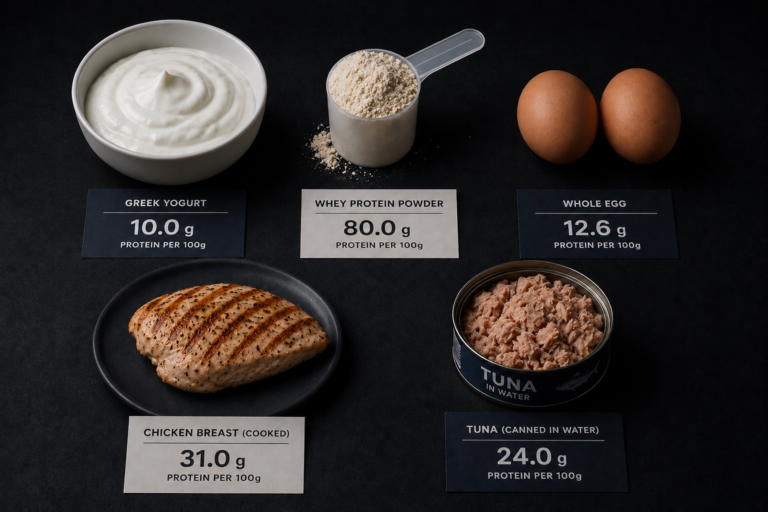
When solid food is the bottleneck, two tools do most of the work. First, protein density: choosing foods that pack the most protein into the least volume, since stomach volume is your binding constraint on GLP-1. The food ranking is in protein-dense foods that actually work on GLP-1. Second, liquid protein, which bypasses the fullness signal that limits solid intake and lets you land a full dose without occupying stomach space you do not have. A dedicated article on the protein shake strategy covers when liquid protein is a clinical tool rather than just convenience.
Key Takeaway
Your protein target on semaglutide is about 2.0 g/kg of bodyweight, with 1.6 g/kg as the floor. That is roughly double the RDA because the RDA was not designed for someone in a sustained deficit trying to keep muscle. Calculate your number once, recalculate it every 15–20 lbs as your weight changes, and treat the floor as the line you defend every day. Protein is the anabolic signal the drug does not give you. On a suppressed appetite, nobody hits that number by accident. You hit it by making the number fixed and building the day around it.
Download the free GLP-1 Starter Framework: the three-lever system for losing fat without losing muscle.
The GLP-1 Nutrition Planning Framework ($17) covers protein targets, deficit management on suppressed appetite, injection day adjustments, and a 12-week tracking spreadsheet for logging it all.
FAQ
How much protein should I eat on Ozempic to keep muscle?
Aim for about 2.0 g per kilogram of bodyweight per day, with 1.6 g/kg as your floor. At 180 lbs (82 kg), that is roughly 164 g target and 131 g floor. This is roughly double the standard 0.8 g/kg RDA, which was designed for sedentary, weight-stable people, not for someone in a caloric deficit trying to preserve lean mass.
Is 0.8 g/kg of protein enough on semaglutide?
No. The 0.8 g/kg figure is the RDA, set to prevent deficiency in the general population, not to protect muscle during weight loss. In a caloric deficit your body breaks down tissue for energy, and without higher protein intake plus resistance training, some of that tissue is muscle. The research-supported range for preserving lean mass is 1.6–2.0 g/kg (Morton et al., 2018).
What happens if I don’t eat enough protein on GLP-1?
You lose more of your weight as muscle rather than fat. About a quarter of weight lost on GLP-1 medications is lean mass on average (Karakasis et al., 2025), and inadequate protein pushes that fraction higher. The visible result is the “skinny-fat” outcome. A lower scale number but a softer, weaker physique, because you stripped muscle along with fat.
Can I get too much protein on semaglutide?
For healthy individuals, intakes up to and slightly beyond 2.0 g/kg show no benefit beyond muscle preservation but also no established harm. The practical limit on GLP-1 is appetite, not safety. Most users struggle to reach the target, not exceed it. If you have kidney disease, discuss protein intake with your physician before raising it.
Do I need to recalculate my protein target as I lose weight?
Yes. Your target is tied to your bodyweight, so recalculate every 15–20 lbs lost. A 168 g target at 185 lbs becomes about 150 g at 165 lbs. Holding the original high number is not harmful, but tracking it down with your weight keeps the deficit-adjusted requirement accurate and the daily logistics manageable.
Nothing on this site constitutes medical advice. I’m not a physician, and this blog documents my own research and experience. Consult a qualified healthcare provider for decisions about medication, dosing, or treatment.
Ryan Mercer | MetabolicMale.com | ryanmercer@metabolicmale.com
Citations:
- Morton RW et al. A systematic review, meta-analysis and meta-regression of the effect of protein supplementation on resistance training-induced gains in muscle mass and strength in healthy adults. Br J Sports Med. 2018;52:376–384.
- Jager R et al. International Society of Sports Nutrition Position Stand: protein and exercise. J Int Soc Sports Nutr. 2017;14:20.
- Helms ER et al. A systematic review of dietary protein during caloric restriction in resistance trained lean athletes: a case for higher intakes. J Int Soc Sports Nutr. 2014;11:20.
- Karakasis P et al. Metabolism. 2025;164:156113.