How Much Protein on Ozempic, Wegovy, or Mounjaro (Exact Calculation)
TL;DR
- Your protein target on Ozempic, Wegovy, or Mounjaro is 1.6–2.0 g per kilogram of bodyweight. In an active deficit, aim for the top: 2.0 g/kg.
- That’s higher than most guidance you’ll see, and the reason is specific to GLP-1: bigger deficit, suppressed appetite, more lean mass at risk.
- Miss it consistently and your body starts burning muscle for fuel. Hit it and the deficit comes out of fat.
- It’s achievable even with a wrecked appetite. I held 200 g a day for about 10 months while losing 48 lbs of scale weight. Here’s the exact calculation and how I actually ate it.
Your protein target on Ozempic, Wegovy, Mounjaro, or any GLP-1 medication is 1.6 to 2.0 g/kg of bodyweight per day. If you are actively trying to preserve muscle in a caloric deficit, target the top of that range: 2.0 g/kg. Here is how to calculate your number and why that figure is not arbitrary.
Download the free GLP-1 Starter Framework, the three-lever system for losing fat without losing muscle.
How to Calculate Your Protein on Ozempic
Step 1: Convert your bodyweight to kilograms. Divide your weight in pounds by 2.2.
Example: 195 lbs ÷ 2.2 = 88.6 kg
Step 2: Multiply by 2.0.
88.6 kg × 2.0 = 177 g protein per day
Step 3: Set your floor. If you genuinely can’t hit 2.0 g/kg, and on a GLP-1 some days you can’t, hold the floor at 1.6 g/kg. Don’t drop below it.
88.6 kg × 1.6 = 142 g protein per day (floor)
For a 195 lb man: 142 g on hard days, 177 g as the daily target. That’s the bracket you’re working within.
Why This Is Higher Than What You’ll See Elsewhere
The recommended dietary allowance (RDA) for protein is 0.8 g/kg. You’ll see that everywhere: nutrition labels, general health guidelines, your GP. That number is the minimum to prevent deficiency in a sedentary person. It’s the floor for survival, not for body recomposition.
You’ll also see a lot of GLP-1 guidance landing at 1.2–1.6 g/kg. That’s fine for general muscle preservation, but it’s built for the average patient, not for someone deliberately training to hold lean mass through an aggressive deficit. For that goal, the research points higher. Helms et al. (2014), in a review published in the Journal of the International Society of Sports Nutrition, looked at lean, resistance-trained athletes during caloric restriction and found higher intakes in the range of 2.3–3.1 g/kg of lean body mass were associated with better lean mass retention. That’s an athlete population at the upper end; for most GLP-1 users, 2.0 g/kg of total bodyweight is the practical target. The ISSN Position Stand on protein and exercise (Jager et al., 2017) supports 1.4–2.0 g/kg for exercising individuals, with the higher end appropriate during restriction.
Here’s what happens if you fall short. In a large, rapid deficit without enough protein, your body doesn’t politely pull only from fat. It catabolizes lean tissue to supply amino acids for gluconeogenesis: converting muscle protein into glucose. Protein intake is what blunts that. On a GLP-1, where appetite suppression can drive the deficit far deeper than you’d manage by willpower, protein isn’t a nice-to-have. It’s the variable standing between fat loss and muscle loss.
Hitting 1.6–2.0 g/kg requires intention. It doesn’t happen passively on a GLP-1.
The Distribution Piece (Don’t Skip This)
Your daily total matters most. But how you spread it across meals matters too. Muscle protein synthesis is triggered on a per-meal basis by reaching the leucine threshold. Leucine is the amino acid that activates the mTORC1 pathway for muscle repair. That threshold is roughly 2.5–3 g of leucine per meal, which works out to about 30–40 g of complete protein per serving.
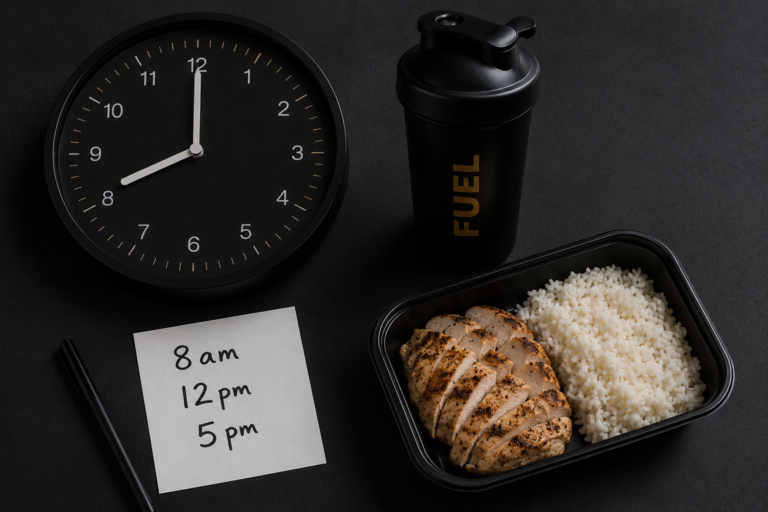
Hit your daily total in two large meals and you trigger that signal twice. Spread 160 g across four 40 g meals and you trigger it four times, with the same total intake. On a GLP-1, where meal volume is constrained, you may not manage four full meals. Work with what you can. But eat protein first at every opportunity, and treat each one as a synthesis trigger, not just a calorie event.
What 200 g Actually Looked Like for Me
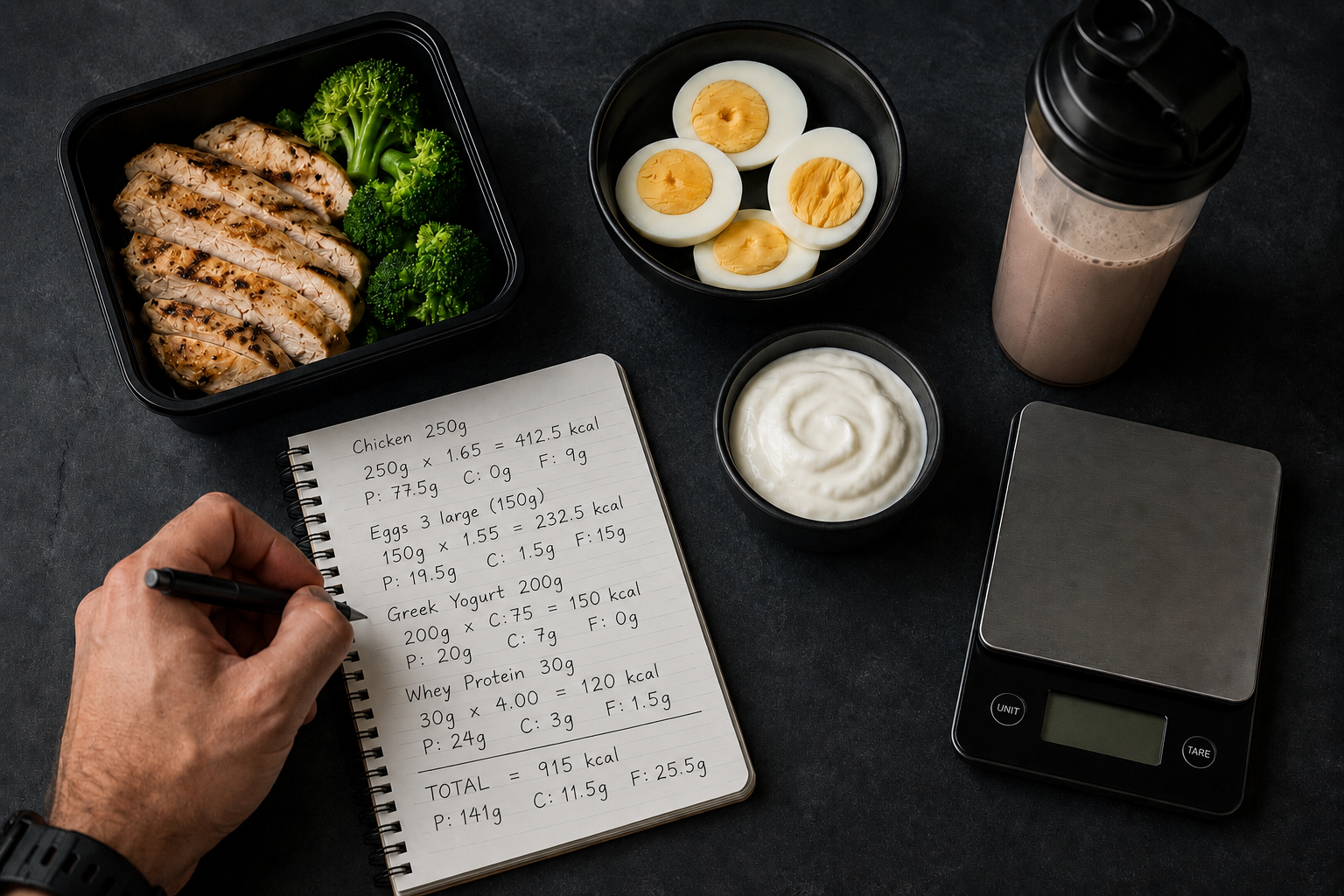
I planned a 750-calorie daily deficit and averaged 628 over the run. The first three weeks the scale dropped 7.5 lbs, but I knew most of that was glycogen and water, not fat. I weighed my food and tracked every calorie from day one, so I could divide my actual tracked deficit by 3,500 and estimate only about 4.25–4.5 lbs of that early drop was real fat. The rest came back the moment carbs did. Tracking is what let me tell the difference instead of guessing.
Protein stayed at 200 g the entire time. Fat ran around 32% of calories, enough to clear the hormonal minimum comfortably and keep training fueled. Carbs filled the rest, sized to support the gym, with 70–80% of them parked around my training.
The day ran like this. Pre-workout, I mixed cream of wheat and a Liquid IV into my morning protein shake. It comes out tasting like a lemon-lime creamsicle, which sounds wrong and works.
After training, a mixed breakfast: a few eggs, Chobani high-protein Greek yogurt, and whatever easy, low-volume carb was around (fruit usually). The rest of the day was lean protein with rice and vegetables. Dinner stayed flexible. I ate what my family ate, and if the meal was light on protein I’d add a grilled chicken breast to my plate.
On a deficit, protein is the anchor; everything else can bend around it. Your mileage will vary, but the structure is the point: protein locked, carbs around training, fat steady, flexibility where it doesn’t cost you.
For nausea days specifically, when volume is hardest, Ozempic Nausea: What to Eat → covers how to hold a protein floor when your stomach won’t cooperate.
What 177 g of Protein Looks Like on a Plate
| Source | Serving | Protein |
|---|---|---|
| Chicken breast, cooked | 6 oz | ~52 g |
| Greek yogurt, plain (2%) | 1 cup | ~20 g |
| Whey isolate shake | 1 scoop | ~25 g |
| Eggs | 3 large | ~18 g |
| Cottage cheese | 1 cup | ~28 g |
| Canned tuna | 1 can (5 oz) | ~30 g |
A day that hits target: Greek yogurt at breakfast (20 g), a shake mid-morning (25 g), chicken at lunch (52 g), cottage cheese as a snack (28 g), salmon or ground beef at dinner (50 g+). That’s over 175 g without forcing large meal volumes, which matters when a GLP-1 has cut your appetite.
The GLP-1 Nutrition Planning Framework covers protein targets, meal structure, injection-day adjustments, nausea-day nutrition, and a 12-week nutrition tracker for managing intake on suppressed appetite.
FAQ
What happens if I don’t eat enough protein on Ozempic?
In a large deficit without adequate protein, your body breaks down muscle tissue to supply amino acids for energy and glucose production. On a GLP-1, the deficit is often deeper than you’d hit by dieting alone, so the muscle-loss risk is higher, not lower. Consistently missing your target is the single most common reason GLP-1 users lose lean mass alongside fat.
Can protein shakes help on semaglutide?
Yes, and they’re arguably the most useful tool you have. Liquid protein moves through a slowed stomach faster than solid food and doesn’t create the same fullness, so a whey shake can deliver 25–35 g when a meal feels impossible. Whey isolate sits better than concentrate on a suppressed appetite. Treat shakes as a volume-efficient protein source, not just convenience.
How do I hit 200 g of protein with a small appetite?
Eat protein first at every meal, lean on dense sources (lean meats, egg whites, Greek yogurt, whey isolate), and add a shake or two to bridge gaps. Spreading intake across four or five small feedings beats trying to force two large ones. On the hardest days, hold a floor rather than chasing the full target: something beats nothing.
Should I eat protein before or after my workout on a GLP-1?
Total daily protein matters more than timing, but a serving in the hours around training is sensible and easy to hit. More important on a GLP-1 is carbohydrate timing: parking most of your carbs pre- and post-workout fuels the session when appetite is low. Protein around training is good; protein hit consistently across the day is what actually protects muscle.
Is 1.6 g/kg enough, or do I need more on a GLP-1?
1.6 g/kg is a defensible floor and will preserve muscle for most people in a moderate deficit. But the deeper and faster the deficit, exactly what GLP-1 medications produce, the more the research favors the upper end. If you’re training and want margin for error, 2.0 g/kg is the better target, with 1.6 g/kg as the line you don’t drop below.
Nothing on this site constitutes medical advice. I’m not a physician, and this blog documents my own research and experience. Consult a qualified healthcare provider for decisions about medication, dosing, or treatment.
– Ryan Mercer | MetabolicMale.com | ryanmercer@metabolicmale.com
References
- Morton RW, Murphy KT, McKellar SR, et al. A systematic review, meta-analysis, and meta-regression of the effect of protein supplementation on resistance training-induced gains in muscle mass and strength in healthy adults. British Journal of Sports Medicine. 2018;52:376-384.
- Jager R, Kerksick CM, Campbell BI, et al. International Society of Sports Nutrition Position Stand: protein and exercise. Journal of the International Society of Sports Nutrition. 2017;14:20.
- Helms ER, Aragon AA, Fitschen PJ. Evidence-based recommendations for natural bodybuilding contest preparation: nutrition and supplementation. Journal of the International Society of Sports Nutrition. 2014;11:20.
- Norton LE, Layman DK. Leucine regulates translation initiation of protein synthesis in skeletal muscle after exercise. Journal of Nutrition. 2006;136:533S-537S.