Does Ozempic Cause Muscle Loss? The Research-Based Answer
TL;DR
- People can lose muscle while taking Ozempic, but the drug is not the direct mechanism. The caloric deficit is, and that is the part you can manage.
- The STEP 1 body composition data showed fat loss outpaced lean mass loss. Body composition improved even as total weight dropped.
- Three variables decide your outcome: protein intake, resistance training, and how fast you lose weight. The drug controls none of them. You do.
- Over roughly 10 months I lost about 52 lbs of fat and added around 4 lbs of lean mass. Not despite the drug, but because I managed the three variables it leaves on the table.
Ozempic can be associated with lean mass reduction during weight loss, but it does not appear to break down muscle directly. The muscle loss comes from the deficit the drug makes easier to sustain, especially when protein, resistance training, and rate of loss are not managed.
People taking Ozempic (semaglutide) do lose lean mass while losing weight. That’s documented in the trial data. But the drug itself doesn’t break down muscle through any direct mechanism. The muscle loss comes from the same forces that drive lean mass loss in any large caloric deficit: too little protein, no resistance training, and losing weight too fast. Ozempic makes the deficit easy to create. What happens to your muscle inside that deficit is determined by your behavior, not the drug. The same is true for Wegovy, which is the same molecule at a higher dose, and for Mounjaro and Zepbound, which use tirzepatide.
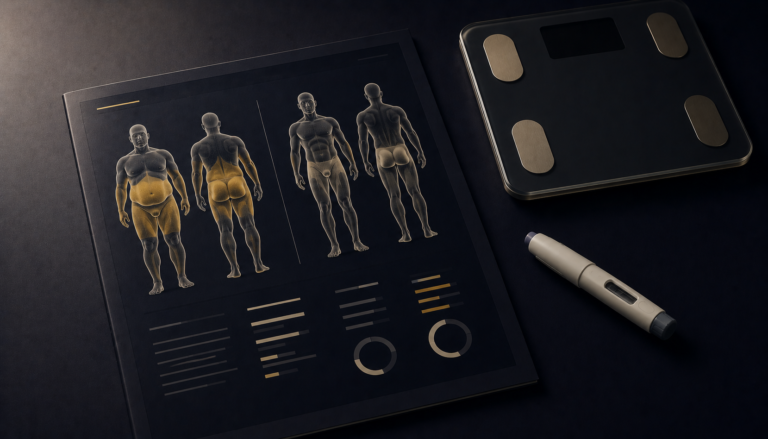
I went from 238 lbs at roughly 33% body fat to 190 lbs at about 14% over the course of my own loss. Lean mass didn’t just hold. It crept up. That outcome wasn’t luck, and it wasn’t the drug. It was three controllable variables, which is what the rest of this comes down to.
Download the free GLP-1 Starter Framework, the three-lever system for losing fat without losing muscle.
What the STEP 1 Trial Data Actually Shows
STEP 1 is the landmark semaglutide weight loss study: 1,961 adults, 68 weeks, subcutaneous semaglutide 2.4 mg versus placebo (Wilding et al., NEJM, 2021). A subgroup of 140 participants (95 on semaglutide, 45 on placebo) underwent DEXA scanning at baseline and at week 68, reported in a separate exploratory body composition analysis (Wilding et al., Journal of the Endocrine Society, 2021). That substudy is where the real body composition picture comes from.
Total lean body mass fell 9.7% from baseline. That sounds alarming until you read the next number: the proportion of lean mass relative to total body mass rose by 3.0 percentage points. The semaglutide group lost both fat and lean tissue, but they lost proportionally more fat. Body composition improved even though absolute lean mass declined. Against a roughly 15% drop in total weight, a 9.7% drop in lean mass means fat carried most of the loss.
The broader GLP-1 evidence points in the same direction. A pooled analysis of 22 randomized trials involving 2,258 participants found lean mass represented about 25% of total weight lost (Karakasis et al., Metabolism, 2025). That is the central number to plan around: not panic, but also not dismiss. The semaglutide picture is not the drug attacking muscle. It is the predictable result of a large deficit when protein and resistance training are not deliberately managed.
Tirzepatide (Mounjaro, Zepbound) produces more total weight loss than semaglutide in pivotal trials, which means lean mass protection matters at least as much, not less. Current body-composition comparisons do not clearly show that tirzepatide is safer for lean mass once total weight lost is considered, so drug choice is a weak lever compared with protein intake, resistance training, and rate-of-loss management.
Why the Drug Doesn’t Directly Cause Muscle Loss
There is no established GLP-1 receptor-mediated catabolic effect on skeletal muscle. GLP-1 receptors sit in pancreatic tissue, the central nervous system, the GI tract, and the cardiovascular system. Skeletal muscle isn’t a primary target tissue for GLP-1 signaling the way it is for insulin.
What these medications do is suppress appetite hard. That suppression creates a deficit most people couldn’t hold through willpower alone. A large, sustained deficit without adequate protein and without a training stimulus produces lean mass loss. The drug is the tool, the deficit is the environment, and your behavior inside that environment determines the outcome.
How to Prevent Muscle Loss on Ozempic: The Three Variables You Control
1. Protein intake. The research case for elevated protein in a deficit is strong. The ISSN Position Stand (Jager et al., 2017) and multiple meta-analyses support 1.6–2.0 g per kilogram of bodyweight for people trying to preserve lean mass. Appetite suppression makes hitting that harder, which is exactly why it takes intention. I held 200 g per day for the entire run, on good weeks and bad. For the full calculation, see How Much Protein on Ozempic, Wegovy, or Mounjaro →.
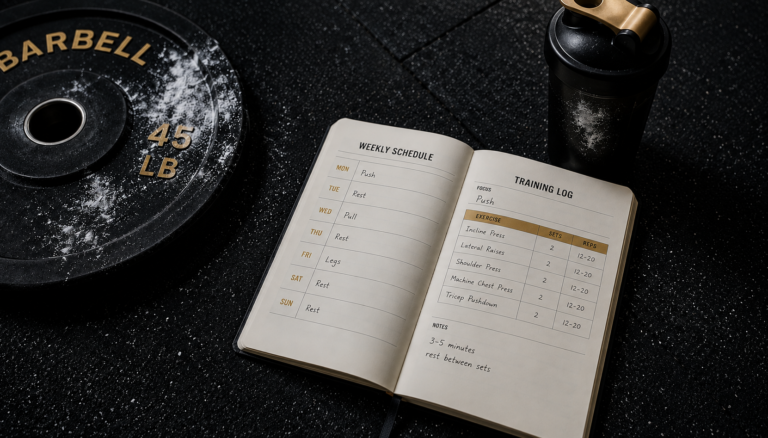
2. Resistance training. A mechanical load is the signal that tells your body lean mass is worth keeping. Without it, the body has no reason to defend muscle in a deficit. I run a 3-day modified push/pull/legs split with double progression, working mostly in the 12–20 rep range. That choice was forced by an FAI diagnosis and a labrum tear confirmed on imaging, which made heavy low-rep work a bad idea for my hips. That higher-rep approach costs nothing in muscle terms: hypertrophy is similar across a broad load range when sets are taken near failure, with heavier loads mainly favoring maximal strength (Schoenfeld et al., J Strength Cond Res, 2017). Two to three honest sessions a week is the floor.
3. Rate of loss. Losing more than roughly 1% of bodyweight per week correlates with higher lean mass loss as a fraction of total weight. GLP-1 drugs can easily push past that. I planned a 750-calorie daily deficit and averaged 628. Fast enough to make real progress, slow enough to protect muscle. Monitoring your weekly rate and managing it deliberately is one of the most underused levers in GLP-1 body recomposition.
I tracked lean mass with periodic DEXA scans, hovering between 14–16% body fat by the end. The data tracked the research exactly: the variable that mattered wasn’t which drug I took. It was whether I hit protein and trained with enough effort.
What This Means If You Just Started
If you’re on Ozempic or Wegovy and you’re worried about muscle, the fear is valid but the frame is wrong. The drug isn’t robbing your muscle. The deficit will, if you don’t manage it. That reframe is an empowering one, because all three variables sit in your control. This site calls them the three levers: protein, resistance training, and rate of loss.
And if nausea is making eating hard right now, Ozempic Nausea: What to Eat → covers how to hold a protein floor on bad days.
For the full framework: protein, training, and tracking in one place: grab the free Starter Framework here →
FAQ
Does Wegovy cause muscle loss?
Wegovy is semaglutide, the same molecule as Ozempic, dosed for weight loss. The muscle-loss picture is identical: lean mass declines during weight loss, but the drug doesn’t cause it directly. The deficit, low protein, and missing resistance training do. Manage protein, training, and rate of loss, and you can materially reduce how much lean mass is lost while improving the odds that most of the weight comes from fat.
How much muscle will I lose on semaglutide?
It depends almost entirely on your behavior. In the STEP 1 DEXA substudy, lean mass fell 9.7% from baseline while body composition still improved (Wilding et al., Journal of the Endocrine Society, 2021). With adequate protein and resistance training, the lean mass fraction of your total loss drops sharply. Without them, it climbs. The drug sets the deficit; you set the ratio.
Can you build muscle while on Ozempic?
It is possible, especially if you are newer to training or carrying higher body fat. I added roughly 4 lbs of lean mass over about 10 months while losing fat. True simultaneous gain is harder for trained lifters, but lean mass preservation, meaning holding what you already have, is achievable across a wide range of people on GLP-1 medications with the right protein and training.
How do I know if I’m losing muscle on a GLP-1?
Strength is the cheapest proxy. If your key lifts hold within about 5% while you lose weight, lean mass is likely preserved. If strength drops sharply alongside the scale, that’s a flag to check protein intake first. DEXA scans give a direct measurement; tape measurements and progress photos help fill the gaps between scans.
Does tirzepatide cause less muscle loss than semaglutide?
Some SURMOUNT-1 analyses suggest a slightly more favorable lean mass picture with tirzepatide, possibly from its dual GIP/GLP-1 mechanism (Jastreboff et al., NEJM, 2022). The data is limited and not a clean head-to-head, so it’s a weak basis for choosing one drug over the other. Your protein intake and training matter far more than the molecule you’re on.
Nothing on this site constitutes medical advice. I’m not a physician, and this blog documents my own research and experience. Consult a qualified healthcare provider for decisions about medication, dosing, or treatment.
– Ryan Mercer | MetabolicMale.com | ryanmercer@metabolicmale.com
References
- Wilding JPH, Batterham RL, Calanna S, et al. Once-weekly semaglutide in adults with overweight or obesity. New England Journal of Medicine. 2021;384:989-1002.
- Wilding JPH et al. STEP 1 DXA body composition substudy. Journal of the Endocrine Society. 2021.
- Jastreboff AM, Aronne LJ, Ahmad NN, et al. Tirzepatide once weekly for the treatment of obesity. New England Journal of Medicine. 2022;387:205-216.
- Karakasis P, Patoulias D, Fragakis N, Mantzoros CS. Lean mass changes with GLP-1 receptor agonist treatment: pooled analysis of randomized trials. Metabolism. 2025;164:156113.
- Jager R, Kerksick CM, Campbell BI, et al. International Society of Sports Nutrition Position Stand: protein and exercise. Journal of the International Society of Sports Nutrition. 2017;14:20.
- Schoenfeld BJ, Grgic J, Ogborn D, Krieger JW. Strength and hypertrophy adaptations between low- versus high-load resistance training. Journal of Strength and Conditioning Research. 2017;31:3508-3523.