
Why Training Near Failure Matters More Than How Many Sets You Do on GLP-1
TL;DR
- GLP-1 users worry about is the wrong worry — the real variable is how close to failure each set gets, not whether you grind every one to a dead stop.
- Sets left with five or more reps in reserve barely register as a growth stimulus. Sets within a few reps of failure do almost all the work.
- On GLP-1 you’re already doing fewer sets, which means effort is the one lever left that you fully control. Two hard sets beat four mediocre ones, and it’s not close.
- Reps in reserve (RIR) is the practical unit. You don’t need a one-rep max or percentages — you need an honest read on how many reps you had left.
- Most people who “do everything right” and still lose muscle are doing real volume at fake effort. This is the fix.
Training to failure on GLP-1 is not the right question. The useful question is how close each set gets to failure, not whether every set ends at a dead stop. The common mistake is counting sets as if they’re all worth the same. Three sets of ten looks like a workout on paper. If the first two stopped six reps short of failure, you did one real set and two warm-ups with a label on them.
What proximity to failure actually means
Proximity to failure is how many more reps you could have done when you stopped. Stop at the rep where the next one would have stalled mid-range, and you trained to failure. Stop with three good reps still available, and you were at three reps in reserve. The closer you stop to that wall, the more of the muscle you’ve actually challenged.
RIR (reps in reserve) as the practical unit
RIR is the number of reps you left on the table. Zero RIR is failure. One to two RIR means you could have done one or two more before form broke. It’s a self-estimate, and it gets more accurate the more you use it — early on most people overestimate how many reps they had left, which means they’re training easier than they think. That gap is exactly where lost muscle hides.
Where the hypertrophic stimulus comes from
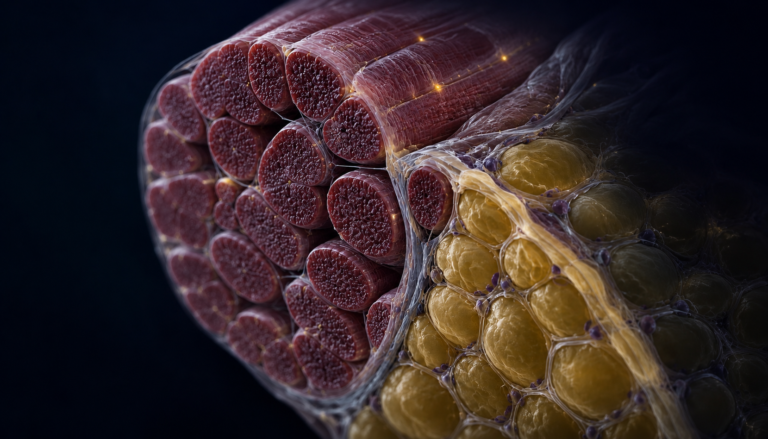
A muscle recruits its motor units in order, smallest first. The large, high-threshold units — the ones with the most growth potential — only switch on when the lighter ones fatigue and the set gets genuinely hard. That happens in the last few reps before failure. A set that ends well short of that point never recruits the fibers that matter. This is the mechanism behind everything that follows: effort isn’t a vibe, it’s the switch that turns the growth-capable tissue on.
Download the free GLP-1 Starter Framework, the three-lever system for losing fat without losing muscle.
What the research shows about effort and MPS
Comparable results from 0–3 RIR versus absolute failure
You don’t have to take every set to a grinding, form-breaking stop to get the benefit. Sets performed within roughly 0–3 reps of failure produce a growth stimulus comparable to sets taken to absolute failure (Schoenfeld & Grgic, Strength Cond J, 2019;41:108-113). That’s the practical sweet spot: hard enough to recruit the high-threshold fibers, controlled enough that you’re not wrecking yourself or your technique. Stopping at one or two RIR on most sets is the target.
Why sets with 5+ RIR significantly underperform
The other side of that finding is the part people ignore. Once you’re leaving five or more reps in reserve, the set drops off the useful part of the effort curve. It’s a lot of mechanical work for very little adaptive signal. On full calories you could bury that inefficiency under sheer volume. On GLP-1, you can’t — which is why the easy-set habit quietly costs people their muscle.
Why this matters more on GLP-1 than in a normal training phase
Lower energy availability means fewer sets — quality becomes the only variable you control
In a normal building phase you have three knobs: volume, effort, and calories. On GLP-1, calories are pinned low by the drug, and volume is capped by what your recovery can absorb on low energy. That leaves effort. It’s the only input you can turn up without paying a recovery cost you can’t afford — and it happens to be the one that decides whether your limited sets do anything.
The arithmetic of 2 hard sets versus 4 mediocre sets
The common mistake is counting sets as if they are all worth the same. Three sets of 10 looks like a workout on paper. If the first two stopped 6 reps short of failure, you did one real set and two warm-ups with a label on them. For GLP-1 users, training to failure is better treated as a dial: how close did the set get, and was it close enough to matter?
On GLP-1 that math isn’t a nice-to-have; it’s the difference between a program your body can sustain and one that grinds you down while underdelivering.
I didn’t discover the RIR framework mid-protocol. I built it in from the research phase, before I started. What the protocol confirmed was a pattern I’d already watched go wrong on previous programs: high volume, lower intensity per set, caloric deficit, declining strength. High-volume programs are built around progressive loading across many sets — which works when energy availability supports recovery.
In a deficit, the per-set quality suffers before the volume does. You end up with more sets at lower effective effort, and the stimulus erodes. Two sets at 1–2 RIR doesn’t have that problem. The effort is the variable the deficit can’t easily take from you the way it takes recovery capacity.
Ryan’s Editorial Note: RIR or RPE can be difficult to judge. I recommend filming a couple sets of your major lifts and perform a post-lift review to judge bar speed. Sometimes in the moment the weight feels like a death-crawl but the video shows it only slowed moderately. This post-lift review will calibrate your internal RIR/RPE “clock” to more accurately represent your true proximity to failure.
Practical Application for Training to Failure on GLP-1
Using RPE instead of percentage of max
Forget percentages of a one-rep max. On a fluctuating deficit, your max moves week to week, so a fixed percentage is a moving target. Rate the set by feel instead: pick a load you can take to about 1–2 RIR in your target rep range, and adjust by how the last set actually went. Autoregulation beats a spreadsheet when your energy isn’t stable.
What 1–2 RIR feels like
At 2 RIR, rep speed has slowed noticeably but the bar still moves with control. At 1 RIR, the next rep would be a genuine fight and you’re fairly sure you’d get it but it would be ugly. At 0, you tried the next rep and it stalled. If you’re ending sets while reps still feel smooth and fast, you’re nowhere near — that’s the most common error, and it feels like training hard when it isn’t.
When to stop: absolute failure versus technical failure
Stop at technical failure — the rep where form starts to break — not at the point where you’re heaving the weight with whatever it takes. On compound lifts especially, grinding past clean technique trades a tiny bit of extra stimulus for a real injury risk and days of junk fatigue. Technical failure on most sets, with the occasional set pushed to true failure on machines or isolation work, is the durable approach on low energy.
The bottom line
Stop counting sets like they’re interchangeable. On GLP-1 you’re working with a smaller volume budget, and the only way that budget buys you muscle is if every set is spent near failure. Two hard sets at 1–2 RIR will out-preserve four sets you floated through, and they’ll cost you less recovery doing it. Effort is the free lever. Pull it.
For how this fits into the minimum amount of training that holds muscle, see the minimum effective training dose on GLP-1. When effort is dialed in and performance still slips, that’s a volume question — covered in when to reduce training volume on GLP-1. The full strength training guide for GLP-1 users puts effort, volume, and structure together.
Download the free GLP-1 Starter Framework — the three-lever system for losing fat without losing muscle. ryanmercer.gumroad.com/l/txhvrr
The GLP-1 Training Protocol ($27) has the full PPL program with both schedule variants, progression rules, GLP-1-specific modifications, and a pre-built Training Tracker spreadsheet. ryanmercer.gumroad.com/l/pxnnup
FAQ
Do I have to train to failure to keep muscle on semaglutide?
No. You need to train close to failure, which isn’t the same thing. Sets taken to within about 0–3 reps of failure deliver a growth stimulus comparable to sets pushed to a dead stop (Schoenfeld & Grgic, 2019), with less injury risk and less wrecking fatigue. Aim for 1–2 reps in reserve on most sets, and save true failure for the occasional machine or isolation set where form can’t break down.
What is RIR and how do I estimate it?
RIR — reps in reserve — is how many more reps you could have done when you stopped. Zero is failure, two means you had two left. Estimate it honestly at the end of each set; most people overshoot, meaning they think they’re closer to failure than they are. It gets more accurate with practice, and logging it next to each set is the fastest way to calibrate your own effort.
Why do two hard sets beat four easy ones on GLP-1?
Because the growth stimulus lives in the last few reps before failure, where the high-threshold muscle fibers finally engage. Easy sets never reach those fibers — they’re volume without signal. On low calories you can’t out-volume that inefficiency the way you could while eating at maintenance. Two sets near failure recruit the right fibers and cost half the recovery of four sets you didn’t push.
Should I go to failure on compound lifts like squats and presses?
Generally no. On heavy compounds, stop at technical failure — the rep where form starts to break — rather than absolute failure. Grinding past clean technique on a loaded barbell trades a sliver of extra stimulus for real injury risk and days of fatigue you can’t spare in a deficit. Reserve true failure for machines and isolation movements where a failed rep is safe.
How do I tell if I’m actually training hard enough?
Watch rep speed and honesty. If your last few reps are still fast and smooth and you’re racking the weight while it feels easy, you’re leaving too much in reserve. Real proximity to failure feels like the bar slowing down and the next rep being a genuine question. If you’ve never had a set where you weren’t sure you’d finish the rep, you’ve probably been training easier than you think.
Nothing on this site constitutes medical advice. I’m not a physician, and this blog documents my own research and experience. Consult a qualified healthcare provider for decisions about medication, dosing, or treatment.
— Ryan Mercer | MetabolicMale.com | ryanmercer@metabolicmale.com
References
- Schoenfeld BJ, Grgic J. Does training to failure maximize muscle hypertrophy? Strength Cond J. 2019;41(5):108-113. https://doi.org/10.1519/SSC.0000000000000473
- Morton RW, et al. A systematic review, meta-analysis and meta-regression of the effect of protein supplementation on resistance training-induced gains in muscle mass and strength in healthy adults. Br J Sports Med. 2018;52(6):376-384. https://doi.org/10.1136/bjsports-2017-097608